
Investigation, last updated 14 October 2026
Wollega: an ongoing erasure
Eight years of killings, and the investigation that never came.
A situation report on the four Wollega zones of western Oromia, January 2018 to October 2026.
Download the report as a PDF (77 pages, numbered paragraphs)
በወለጋ ለሚሰቃየው ወገኔ
ከሰው ኑሮ አጉድለው የሰው ሞት ቢነሱህ፣
ቢሰድቡህ ቢያስሩህም ቢያሳድዱህ ቢያርዱህ፣
ከሰውነት ሳትጎል ከእምነትህ ሳታጎል፣
ከነክብርህ ሞተህ ለአገር ስትጎድል፣
የቁም ሟች አበዛህ ላይኖር የሚገድል።
The finding of this report is not who killed. It is that the question is hard to answer, and has been left unanswered for eight years. The erasure is of the record as much as of the people.
The first half of that sentence is established in this report. The second — that a population is being erased — is the hypothesis it asks to be tested, since no one has counted the Amhara of these zones since 2007.
This report documents violence against Amhara and Orthodox civilians because that is the dominant pattern the record holds for these zones. It does not claim they are the only victims, and it documents violence against Oromo civilians as part of the same record.
Summary
- The finding
- Civilians identified as ethnic Amhara and Orthodox Christians have been killed in the four Wollega zones in a recurring pattern between 2018 and 2026. Amnesty International (at Gawa Qanqa) and Human Rights Watch (at Tole) report, from the accounts of survivors and residents, that security forces withdrew shortly before the attacks; at Tole, Human Rights Watch adds that government forces arrived only after the attackers had left. Residents quoted by BBC Amharic report a similar withdrawal at Gida Ayana before the attack of 23 December 2025; it remains unverified. The failure to protect civilians is documented; the identity of those responsible for the killings has not been conclusively established.
- The scale
- ACLED records 1,997 civilian fatalities in events coded as violence against civilians across the four Wollega zones between 2018 and August 2025 — a floor, not an estimate. For the single deadliest incident (Tole, June 2022), four organisations published four different tolls, from about 400 to 1,551; HRW, Amnesty International and the Amhara Association of America lie between 400 and 554. No population-based mortality study has ever been conducted for these zones, as one was for Tigray.
- The accountability gap
- Eight years of killings have passed without a single investigation, and no prosecution is publicly recorded for any incident in this report. The one international mechanism mandated to investigate the conflict, ICHREE, was dissolved in October 2023 — the month in which it warned that all eight common risk factors for atrocity crimes were present in Ethiopia. No replacement has been established.
- The measurement problem
- On the one Ethiopian conflict where both instruments were applied, event coding and a population-based study diverged by an order of magnitude. The peer-reviewed literature on conflict measurement predicts the direction and shape of that gap, and identifies a bias in which killings attributed to state forces are more likely to go unrecorded. Every documented obstacle to verification in Wollega makes the recorded figures smaller than the real ones, never larger.
- What this report does not claim
- It does not conclude that genocide has occurred; that determination belongs to a competent tribunal, and none has examined the evidence. It does not determine who fired the shots; attribution is contested incident by incident, and the record implicates more than one armed actor, including the federal army against Amhara civilians at Merawi. It does not claim that Amhara civilians are the only victims; violence against Oromo civilians is documented in the same reports and the same zones.
- What would change its conclusions
- Credible evidence that the incidents did not occur, or occurred on a smaller scale; that the attribution is wrong; that the deaths were primarily combat rather than deliberate attacks on civilians; that the withdrawals had an operational explanation; that the incidents are separable rather than a pattern; or that an independent mechanism has examined these events and reached findings this report has not taken into account. Each is a question an investigation with field access could answer within months.
- What it asks
- An independent international investigation with genuine field access, including a population-based mortality study; protection of civilians and restoration of humanitarian access; the lifting of restrictions on information and communications; and accountability — public statements naming Wollega, targeted sanctions against officials already named in published investigations, a renewed international investigative mandate and, in the longer term, prosecution in national courts exercising universal jurisdiction.
Full report: 132 numbered paragraphs, four parts.
The evidence that carries the most weight
The finding of this report
1Civilians identified as ethnic Amhara and as Orthodox Christians have been killed in the Wollega zones in a recurring pattern between 2018 and 2026 — selected by identity in the incidents where that mechanism is documented, struck repeatedly in the same localities, and, in two of the incidents examined here, left without protection when it was withdrawn. At Gawa Qanqa and at Tole, Amnesty (at Gawa Qanqa) and Human Rights Watch (at Tole) reported, from the accounts of survivors and residents, that the forces charged with protection left in the hours or days before the attack; at Tole, Human Rights Watch adds that government forces arrived only after the attackers had left. Residents quoted by BBC Amharic report a similar withdrawal at Gida Ayana before the attack of 23 December 2025; it remains unverified.
2Two different questions have to be kept apart here. Who fired is not established. Who failed to protect is. The withdrawal of security forces before an attack is an omission by identified state forces, recorded by Amnesty International at Gawa Qanqa and by Human Rights Watch at Tole, and it does not depend on knowing who did the killing. Responsibility for the killings themselves cannot be settled from outside the country on the record now available. Human Rights Watch, Amnesty International and the Ethiopian Human Rights Commission attribute the deadliest incidents to the Oromo Liberation Army. A Reuters investigation reported that a regional security committee ordered killings elsewhere in Oromia and that, in one case, officials were told to blame the insurgency; the chairman of the state commission confirmed the committee’s existence and said it had overreached. Every attribution in these zones, including the ones this report reproduces from Human Rights Watch and Amnesty International, has not been independently adjudicated, and the reliability of each attribution depends on the evidence available to the investigators who made it. In this region that assumption has been shown false once, in a case Reuters documented and the state commission’s own report supported, and tested never. We are not claiming it is false here. We are saying that no one has checked, and that a report which pretended otherwise would be guessing.
3Neither account has ever been tested. The commission that might have done so was dissolved in 2023. No mortality study has been conducted for these zones. No prosecution is publicly recorded for any incident in this report.
Two counts stand side by side, and this report keeps them apart: 1,997 reported civilian fatalities in events ACLED codes as violence against civilians between 2018 and August 2025, and more than 68 named by the Amhara Association of America between 18 and 29 August 2026. They are not of the same kind — the first is coded from reported events by a dataset that undercounts, the second is a preliminary count its author expects to rise — and this report does not add them. Each is a floor within its own window, and between the two windows lie thirteen months the coded record does not cover at all.
That is the finding stated at the head of this report, and the three points above are what it rests on.
An archpriest taken from the altar during a service, stripped of his vestments, and killed — with the video of it circulating afterwards.
And the only dedicated international mechanism established by the UN Human Rights Council to investigate the conflict, the Commission of Human Rights Experts on Ethiopia (ICHREE), was dissolved in October 2023 while still calling for further investigation; no replacement mechanism exists.
This report does not conclude that genocide has occurred; that determination belongs to a competent tribunal, and no tribunal has examined the evidence. It sets out four concrete requests at its close: an independent international investigation with genuine field access, including a population-based mortality study of the kind already conducted for Tigray; protection of civilians and the restoration of humanitarian access; the lifting of restrictions on information and communications; and accountability against impunity — public statements naming Wollega specifically, targeted sanctions against officials already named in published investigations, a renewed international investigative mandate, and, over the longer term, prosecution before national courts exercising universal jurisdiction.
What is happening
The front as it stands in mid-October 2026, and how the region came to this. about 9 minutes Graded items V 1 · D 5 · C 0 · R 9 · ○ 1
What is happening now
When these lines were first written, in the closing days of August 2026, the Wollega region was once again the scene of mass violence against its Amhara inhabitants; the sequence below was carried forward to 14 October 2026 with what the record has added since. What follows is reconstructed from sources that are scattered and, for the most part, unverified. Each element below is placed on the scale of proof set out later in this report, and the strongest tier is empty, because a reader weighing this report needs the actual sequence, not only its outcome.
The trigger appears to have been military rather than an atrocity out of nowhere, and what follows is corroborated in its broad shape across several otherwise-unaligned accounts.
July to 15 October 2026, entry by entry
July to October 2026, day by day
- 3 JulAir strikeThe Amhara Association of America’s statement of 1 September records an air strike across residential localities of Kiremu, Gida Ayana and Limu Gelila districts, among more than 77 aerial strikes it counts over the period in four regions. No separate toll is given for Wollega, and this report applies none. The same statement counts 226 civilians killed since July across 45 districts in four regions — a national figure, not a Wollega one.
- 8 AugFightingAt Fandaqaa kebele, Gida Ayana, ACLED records OLA fighters under Jaal Mose giving cover to Oromia’s Gadaa Commando and the kebele militia against the Bizamo Command — the first coordination of its kind on record, which ACLED’s local sources describe as the protection of civilians by one commander rather than the movement. On one day in August the insurgency and the regional state fought on the same side. The same analysis records Fano activity in the four Wollega zones up by 80 per cent between January and August 2026 against the same months of 2025, and the Bizamo Command established in December 2024.
- 8–9 AugFightingGovernment-aligned forces — Oromia Special Forces, Geda Commando units, militia and police — advance into the Anger-Gutin area of Gida Ayana district. Fano units reportedly inflict heavy losses, more than seventy dead by some accounts, and seize weapons. Government forces withdraw, then return in force.
- 12 AugReportedThe Oromia News Agency, the regional state’s agency, reports more than thirty civilians killed at Andode Dicho, attributed to Fano forces on the account of eyewitnesses; no official is named and no independent corroboration has been located. It is the one account of the August sequence that names Oromo victims, and this report carries it at the level it holds.
- from 10 AugCiviliansIn the days after that battlefield setback, Oromia regional forces are reported to have killed between twenty and thirty Amhara civilians at Anger-Gutin, among them women, elderly residents, medical staff and people inside a mosque, in what several accounts describe as retaliation.
- 13 AugCiviliansIndividual killings reportedly continue through the week, including a motor-taxi driver.
- 18–29 AugCiviliansThe period the AAA documents: attacks across Gida Ayana and Limu Gelila — Mender 22, Mender 3, Andode, Bechbech, Anger-Gutin town. Four historic Orthodox churches burned to the ground. The archpriest of Andode Selassie removed from the monastery during a service, stripped of his vestments and killed, with video circulating afterwards.
- 19 AugCounted separatelyAn armed attack strikes a vehicle carrying bank cash under federal escort out of Gida Ayana, killing several people including two named bank officials. ACLED dates the ambush to 19 August at Tulu Lencha and attributes it to the Bizamo Command of the Wollega Fano militias, linked to the Amhara Fano National Movement, recording at least sixteen dead: six passengers, one patient, a midwife, three bank managers and five soldiers. Eleven of those sixteen were civilians, and this report counts them, because the unit of account here is the civilian, whatever the target and whoever the perpetrator. Six passengers, a patient, a midwife and three bank managers were killed on a public road, and they belong in the civilian record for August 2026 as much as anyone killed at Gida Ayana.
- 19–21 AugProtestsFour demonstrations at Gida Ayana, Anger Gutin and Wollega University demand an end to Fano attacks, as ACLED records them. They belong in the same chronology: the district’s Oromo residents were also asking to be protected.
- 25–29 AugReportedDiaspora outlets and a field appeal describe a toll beyond four hundred, more than three hundred homes burned and roughly fifteen thousand displaced. Uncorroborated.
- 1 SepDocumentedThe AAA publishes its preliminary report: more than sixty-eight civilians confirmed killed, broken down by kebele, with the toll expected to rise.
- 1–4 SepReportedThe AAA’s weekly bulletin records federal and regional forces, backed by Qeerroo, moving on the Ali and Meleketa areas of Andode-Dicho kebele on 1–2 September, shelling residential quarters, forest hideouts and the compound of the Nigulo-Gabriel church with heavy weapons including tanks, and, on 3–4 September, artillery on the sites where displaced residents were sheltering, after which hundreds were detained. Casualty tolls are given as unconfirmed. Single source; no corroboration located.
- 4 SepCounted separatelyAn armed attack on the Tulu Kapi gold project at Ganji, West Wollega, with multiple fatalities among security personnel, community members and one employee, as recorded in KEFI Gold and Copper’s regulatory filing of 7 September, which suspends all development; no casualty figure is given. The OLA’s notice of 14 September to extractive companies invoked Tulu Kapi without claiming it. On 29 September the company reported its financing fully closed. The money is there; the security is not.
- 17 SepDocumentedThe OLA states, in a press release, that the armed force operating in Wollega under the Amhara name is a small armed group that was initially trained, armed, and deployed directly by the regime, to help counter the OLA, and urges Amhara forces to dissociate themselves from it; the Fano movement’s spokesman had said the day before that the unit is led by youths born in Wollega. The dispute is set out under Who the Wollega force is.
- 20–26 SepDocumentedSeven movements, the TPLF, the OLA and the Amhara Fano National Movement among them, announce an Ethiopian Peoples’ Forces Alliance for Survival; a large offensive opens on 23 September in Tigray, Afar and Amhara. The OLA’s own release of 17 September states that it is neither involved in, nor a component of Tsimdo, while describing an opposition cooperation taking shape; ACLED assessed on 26 September that only three members were fighting. Jawar Mohammed said he had not seen anything as unpopular among the Oromo, after years of accusations that Fano fighters killed Oromo civilians in Wollega. The record this report assembles has become the political cost of the alliance.
- 23 SepFightingDay-long fighting at Andode-Dicho after an offensive by the Wollega unit against a Gadaa Commando camp at Shashober, reinforced with mechanised units and federal tanks, as the AAA bulletin reports it. Single source.
- 29–30 SepDocumentedOromia merges its twenty-one zones into six clusters, each under a vice-president; the western cluster groups the four Wollega zones. The administrative counterpart for any investigation this report asks for has changed.
- 3 OctCiviliansRegime troops move from three directions on the Meleketa and Dicho Sefer localities of Gida Ayana; the AAA bulletin records heavy-machine-gun fire, retaliatory actions against civilians with an unconfirmed number of dead and injured, and residential areas burned. Single source; the toll is not given and this report carries none.
Two things in that sequence need holding apart, and this report holds them apart deliberately. The attack on the bank convoy of 19 August belongs to the chronology of violence in the same district, and the eleven civilians killed in it are counted here, because the unit of account in this report is the civilian and not the target.
Who was killed
The AAA report records that the great majority of victims were Amhara and Orthodox, and that Tigrigna-speaking and Muslim residents were also among them — a distribution this report notes rather than sets aside, because it obliges the investigation to distinguish ethnic, religious and conflict-related targeting instead of collapsing them into one.
Why the figures disagree
By 25-29 August, diaspora-based outlets and a field appeal relayed by the Africa researcher Martin Plaut were describing a toll "beyond four hundred," more than three hundred homes burned, and roughly fifteen thousand people displaced. We cannot corroborate that aggregate figure independently, and it sits well above the twenty-to-thirty figure attached to the more corroborated Anger-Gutin episode; the gap between the two numbers should be read as a measure of how little independent verification has reached this story, not as license to choose whichever figure suits the argument. What is separately and more solidly agreed among independent accounts is the killing of the Orthodox archpriest Qomos Aba Tadesse, removed from the monastery of Andode Selassie during a service, stripped of his vestments, and killed, with video of his treatment circulating online.
Who the Wollega force is
Three names are in use for one armed force, and no one says who commanded it between December 2024 and January 2026. ACLED calls it the Bizamo Command of the Wollega Fano militias, established in December 2024. The Amhara Fano National Movement — formed in January 2026 by bringing the Fano factions of Gojjam, Wollo, Gonder and Shewa under one chairman, Zemene Kassie — claims it: Zemene told Le Temps on 16 August, as Addis Standard reports the interview, that the groups of the Wollega area are now under a single national movement and a single command, and his spokesman calls the unit the Ayisha Said Command, led by youths born in Wollega; the AAA’s bulletins write AFNM-ASC. The OLA, in a press release of 17 September, calls it a small armed group claiming to operate in the name of the Amhara, initially trained, armed, and deployed directly by the regime, to help counter the OLA during the war against the TDF and the OLA, and urges Amhara forces to dissociate themselves from it; an OLA official had told the same paper on 21 August that whether called Bizamo or Ayisha, there is no Fano in Wollega. This report takes no side between them. It records that the question it has asked since its first draft — which unit strikes in Wollega, and under whose command — is now contested in public between two parties whose cooperation was being negotiated at the same time — the OLA says it is not a component of the alliance announced on 20 September — and that the OLA’s allegation of a federal origin, which this report carries at the level of a claim by a party to the conflict, is the same allegation Part II examines.
What is known about August 2026, by standard of proof
- V Independently verifiedNothing. No international organisation, no state commission and no news bureau has verified a toll on the ground. The zone was still described as insecure at the time of writing.
- D Documented by name, incident by incidentThe Amhara Association of America, in a preliminary report updated 1 September 2026, confirms more than 68 civilians killed between 18 and 29 August across Gida Ayana, Limu Gelila and surrounding areas, broken down by kebele: 23 in Mender 22, 21 in Mender 3, 17 in Andode, 5 in Bechbech, 2 in Anger-Gutin town. It names individual victims, records four Orthodox churches burned to the ground, and states the toll will rise as blockaded settlements are reached.
- R Reported by diaspora monitoring channelsBetween twenty and thirty civilians killed at Anger-Gutin, attributed to local sources. The AAA count records two dead in Anger-Gutin town itself and the remainder elsewhere in the district, so the two accounts do not describe the same perimeter and cannot simply be compared.
- ○ Circulating without corroboration“Beyond four hundred”, carried by a field appeal of 29 August. No source has been able to substantiate it. This report does not adopt it.
The disagreement is itself the finding. Four standards of proof produce four different numbers for the same three weeks, and none has been tested by anyone with access to the ground. This report adopts none of them as a total. What it asserts is narrower: that more than sixty-eight civilians have been named, by locality, in a dated document that can be produced.
The same district, two years earlier
This is not the first time this specific district has seen this specific pattern. BBC Amharic reported that on 15 March 2024, government forces killed a large number of people attending a religious celebration in Andode Dicho kebele, in this same Gida Ayana woreda. The Ethiopian Human Rights Commission said it had assigned experts to investigate; East Wollega zone's own security chief told the BBC the killing "did not take place" at all. We have found no public record of that 2024 investigation's outcome.
- Government forces kill a large number of people attending a religious celebration (BBC Amharic).
- The Ethiopian Human Rights Commission says it assigned experts to investigate.
- East Wollega’s security chief tells the BBC the killing did not take place.
- Oromia regional forces are reported to have killed between twenty and thirty Amhara civilians, among them women, elderly residents, medical staff and people inside a mosque.
- Several accounts describe retaliation after heavy losses against Fano units.
"Over four hundred dead, thousands displaced, homes destroyed, attacks on places of worship. The purpose of genocide prevention is to act before the irreversible is reached."
Field appeal, 29 August 2026 (uncorroborated toll; see above)
Seven moments carry the argument. The full chronology of fourteen, with sources for each, opens separately.
- April 2018A new government, and a new insurgency
Abiy Ahmed takes office. The OLA returns from exile and is allowed in without disarming. - 1–2 Nov 2020Gawa Qanqa — the schoolyard 32–54 killed
Civilians gathered in a school compound in Guliso and shot. Federal troops had withdrawn from the area the day before, without explanation. Human Rights Watch records the same sequence in its annual survey of the year: after federal forces left the area, unidentified armed groups attacked mainly Amhara residents in Guliso, killing dozens. HRW’s words are unidentified armed groups, and this report keeps them. - 18 June 2022Tole — the deadliest day 400–554 killed
Eight hours of killing in West Wollega. Four organisations later published four different tolls for the same day; our ACLED export contains no event for it. - 4 July 2022Hawa Gelan 150–308 killed
Two weeks later, and 200 kilometres away, the same pattern in Kellem Wollega. The OLA denied it and blamed government militias. - October 2023The one mechanism, dissolved
The mandate of the UN Commission of Human Rights Experts on Ethiopia is not renewed. It had warned that all eight of the common risk factors in the United Nations Framework of Analysis for Atrocity Crimes were present in Ethiopia — an assessment it set out in its analysis of the acute risk of further atrocity crimes. - February 2024The committee, and what it was found to do
A Reuters investigation reveals the Koree Nageenyaa, a security committee ordering killings and detentions. The state human rights commission confirms it exists. - 8–29 Aug 2026Anger-Gutin — the current front 20–30 killed
Killings reported in East Wollega while this report was being written. The figure is not settled and is carried here as reported.
How Wollega changed
It is important to be precise about what changed, and when. Wollega has long been a region of mixed settlement, and frictions over land between Oromo inhabitants and Amhara communities settled there over the past century were not unknown. That is not to say the years before 2018 were peaceful, and this report does not claim it. Amhara families were resettled into these lowlands in three waves — the sequence is set out by Asebe Regassa and Gemechu Abeshu in the Addis Standard article that argues against this report, and we take it from them: from Wollo into what is now Gida Ayana in 1971, at a place called Gutin — the Anger-Gutin of August 2026; from the north after the famine of 1984–85; and from Gojjam after 1996. Academic work on East Wollega — Feleke Habtamu, Inter-Ethnic Conflict and Eviction in Post-1991 Ethiopia: The Case of Oromia, and Tesfaye Tafesse’s field study of Amhara migrant-settlers in the same zone — records repeated inter-ethnic conflict and eviction from 1991 onward, and gives a prominent role to the instigation of local officials. The account that runs against this report holds that the first major episode came in 2001 at Gida Kiramu, when Amhara settlers raised the question of self-rule and expelled Oromo residents. We record all of it.
What changed after 2018 is not the existence of conflict but its form. Land disputes, evictions and reprisals are one thing; single-day attacks killing dozens or hundreds of assembled civilians, recurring in the same localities across eight years, are another. The window of this report opens in 2018 for that reason, and not because nothing happened before.
Before 2018: what the record does and does not show646 words · the seventeen years this report otherwise passes over, and 1989–1992
The seventeen years this report skips, and what is in them
Between 2001 and 2018 this report says nothing, and a reader is right to ask what is there. The answer is that the period is documented, chiefly in academic work, and chiefly by researchers writing from the Oromo side. We set out what they record rather than leave a silence that would look like a choice.
- 1968–1985Two organised resettlement waves bring Amhara families into these lowlands: the imperial Third Five-Year Plan, which places Wollo families at Gutin in Gida Ayana in 1971, and the Derg’s famine response, which the Oromo account puts at more than 250,000 people moved from drought-affected northern provinces into Wollega.
- 1997–2003Up to 80,000 further settlers arrive from Gojjam into Gida Ayana, Kiramu, Limmu and Horo Guduru. Addis Standard records that the Oromia regional state and its local authorities accommodated them rather than removing them.
- 2000–2001The first major episode of the modern conflict, in the then Gidda Kiremu district. Oromo sources record more than 10,000 people displaced, some 500 homes of Oromo residents destroyed and 3,000 head of livestock looted, in violence they attribute to Amhara settlers raising the question of self-rule. We reproduce that account; we have found no counter-account of the same episode.
- 1994–2017The period is the subject of a small but real academic literature on these exact districts: Oljira Tujubaa on Oromo–Amhara relations in Horro Guduru (1994), Assefa Tolera on Kiremu (1995), Tesfaye Tafesse’s field study of Amhara migrant-settlers in East Wollega (OSSREA, 2007), and Zelalem Teferra’s study of Gidda and Kiremu in the Journal of Eastern African Studies (2017), based on fieldwork through the early 2000s. What they describe is competition over land and administration, with displacement running in both directions.
What they do not describe is a single-day attack killing dozens or hundreds of assembled civilians. That form appears in this record from 2020 onward. The distinction is the whole justification for the window, and it is a distinction about form rather than about the existence of conflict.
What the record holds for 1989–1992, and what it does not. The period is not blank. Africa Watch’s Evil Days (1991) documents an OLF insurgency in western Wollega from 1989, fed by the resettlement and villagisation programmes, with large-scale abuses by the army and reprisals against settlements. It records that when the OLF took Asosa in January 1990 — then in Wollega province — there was at least one incident in which Amharic-speaking civilians were deliberately killed, shot or burned according to different versions, and that full details have never come to light. The same report’s chapter on resettlement documents the emptying of the Wollega sites: population losses above twenty per cent on official figures, some 75,000 returns to Wollo alone. After 1991, the literature on settler return agrees that most Derg-era settlers left for their regions of origin, for a mix of reasons — the end of coercion, the hostility of host communities, insecurity — rather than by a single organised expulsion. What we have not found is a documented account of an organised, violent expulsion of Amhara civilians from these zones in 1991 and 1992 as a distinct event. Such events are documented for that period elsewhere in Oromia, at Arba Gugu and Bedeno in Arsi and East Hararghe. That makes the absence of a comparable file for Wollega a gap in documentation, not evidence that nothing happened; and Evil Days, published in 1991, stops at the threshold of the transition and cannot speak to 1992. HRW’s Reckoning Under the Law (1994) covers the transitional period and is the next place to look.
The turning point has a date and a political context. In April 2018 Abiy Ahmed became prime minister; the Oromo Liberation Front returned from exile; and in October of that year its armed wing, the Oromo Liberation Army, refused to disarm, broke away, and established itself in Wollega, from which it launched an insurgency. From late 2019 the region became a theatre of insurgency and counter-insurgency, and the violence, as the conflict-monitoring group ACLED records, grew markedly more severe, reaching its peak in November 2022.
From that point the killings followed one another with a terrible regularity. In November 2020, at Gawa Qanqa in West Wollega, between thirty-two and fifty-four Amhara civilians, mostly women, children and the elderly, were killed in a schoolyard, a day after government forces had unaccountably left the area. In August 2021, around a hundred and fifty were killed at Gida Kiremu. In June 2022 came the deadliest of all, at Tole, in Gimbi district: over the course of a single morning, several hundred people were murdered house by house, and hundreds of homes burned. Residents buried the dead in mass graves, Human Rights Watch recorded; it counted twelve charred bodies in one burned house at Gutin, five of them children under eight, and some sixty people buried in the compound of the mosque at Silsaw, where a kebele official told it that the majority of the victims were women and children. Amnesty International, interviewing survivors, found the same: most of those killed were unarmed women and children, among them newborns, and a family of twelve burned in their house and buried where they lay. A week later, at Hawa Gelan, the pattern repeated. The sequence did not end: Ano in 2023, and, most recently, Gida Ayana in December 2025 and again in August 2026.
| Date | Site | Toll | Source |
|---|---|---|---|
| Nov 2020 | Gawa Qanqa, West Wollega | 32-54 killed | Amnesty International; EHRC |
| Aug 2021 | Gida Kiremu, East Wollega | ~150 killed | EHRC |
| Jun 2022 | Tole, Gimbi district | 400-554 killed | HRW; Amnesty (satellite-corroborated); AAA (554, named list) |
| Jul 2022 | Hawa Gelan, Kellem Wollega | 150-308 killed | BBC; AAA |
| Nov 2022 | Keerimu, East Wollega | ~280 killed (unconfirmed) | GPE, to corroborate |
| Dec 2025 | Gida Ayana, East Wollega | 19 killed | BBC Amharic |
| Aug 2026 | Gida Ayana (Anger-Gutin) | 20-30 killed (reported, developing) | diaspora field reports, unverified |
What the unmapped months contain
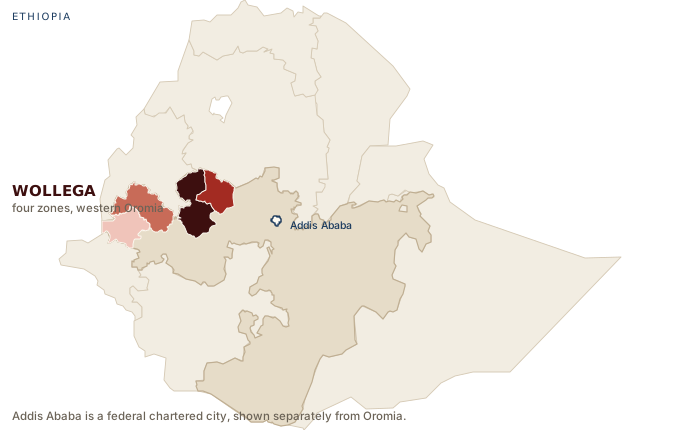
The map stops where the event dataset stops. It does not follow that nothing happened after August 2025. What follows is drawn from two instruments the map does not use: the monthly conflict tracker of the International Crisis Group, which records developments for policymakers, and the weekly bulletins of the Amhara Association of America, which name woredas incident by incident. Neither is comparable to the coded dataset, and nothing here is added to the 4,646 or the 1,997.
- Nov 2025A regional prosecutor shot dead and three colleagues abducted in East Wollega, attributed by the tracker to suspected OLA militants.R Reported
- Dec 2025Nineteen killed at Gida Ayana, East Wollega.D Documented
- Jan 2026Eleven telecom workers abducted in West Wollega on 9–10 January.R Reported
- Jan–Feb 2026Civilian casualties in Abe Dongoro, Horo Guduru Wollega, in a weekly bulletin naming both Oromia Commando units and the OLA.D Documented
- Apr 2026A drone strike in East Wollega destroying residential property, alleged against the military by the OLA and recorded as such.R Reported
- Jul 2026The insurgency described as still active in Oromia, with fighting decreased.R Reported
- 18–29 Aug 2026More than sixty-eight civilians killed across Gida Ayana and Limu Gelila, named by kebele.D Documented
- Early Sep 2026Regional units and allied militias reported to have opened fire on homes in Village 17, Hawa Gelan, Kellem Wollega.R Reported
- 1–4 Sep 2026Shelling of residential areas, a church compound and displaced people’s shelters at Andode-Dicho, Gida Ayana; hundreds detained. Casualties unconfirmed.R Reported
- 4 Sep 2026Armed attack on the Tulu Kapi gold project, Ganji, West Wollega, with multiple fatalities; development suspended by the company.D Documented
- 23 Sep 2026Day-long fighting at Andode-Dicho around a Gadaa Commando camp at Shashober.R Reported
- 3 Oct 2026Retaliatory actions against civilians at Meleketa and Dicho Sefer, Gida Ayana; dead and injured reported, number unconfirmed; homes burned.R Reported
Twelve entries where the coded record has none. That is not a substitute for the data, and it is not offered as one. It is the difference between a gap in the evidence and a gap in the violence, and this report is careful never to present the first as the second.
Four instruments accompany this report. They are built to be opened, searched and checked rather than read in sequence, and each opens full screen.
What is established
The apparatus behind part of the violence, the language that preceded it, and the institutions struck. about 9 minutes Graded items none in this part — prose, not graded one by one
The state security apparatus, and the question of command responsibility
In February 2024, Reuters published the result of a months-long investigation, drawing on more than thirty officials, judges, lawyers and victims, together with internal documents. It revealed the existence of a secret body within the Oromia regional government, the Koree Nageenyaa, or "Security Committee," operating since 2018 and chaired, according to Reuters' reporting, by Shimelis Abdisa, the region's president and Abiy Ahmed's former chief of staff, an attribution we repeat as reported by Reuters, not as a judicial finding. The committee, Reuters found, had ordered hundreds of arrests and dozens of killings. Most tellingly, it had orchestrated the 2021 massacre of fourteen Karrayyu community leaders and then instructed the regional communications bureau to attribute the crime to the insurgency. The 2024 report of the United States State Department echoed these findings.
Two elements raise this above the status of a press allegation. Reuters put its findings to Daniel Bekele, head of the state-appointed Ethiopian Human Rights Commission, who confirmed that the committee exists and said it had overreached its purpose by interfering in the justice system, with widespread human rights violations; he stated that the Commission had itself documented extrajudicial killings, arbitrary detentions, torture and extortion. An intelligence official separately told Reuters that 1,006 people were arrested on the committee’s orders between 2019 and March 2022.
AAGE filmVoices behind the walls1 July 2026 · 10 min 30 sEleven of the political prisoners of the Amhara crackdown — journalists, doctors, teachers, lawyers and elected officials — named and verified, standing for the more than 300 the written investigation documents at minimum and the thousands a December 2024 appeal by fifteen diaspora organisations describes. All five Ethiopian journalists in the Committee to Protect Journalists’ 2025 prison census face terrorism charges carrying a possible death sentence for covering this one conflict. The written investigation carries twenty-seven sources. Material we produced, not independent verification.The existence and the conduct of this body are therefore not contested by the Ethiopian state’s own human rights institution.
- 1Press investigation · Reuters, February 2024More than thirty officials, judges, lawyers and victims, plus internal documents. A secret body, the Koree Nageenyaa (“Security Committee”), operating since 2018.
- 2Confirmed by the state’s own institution · Ethiopian Human Rights CommissionIts head, Daniel Bekele, confirmed that the committee exists and said it had overreached. The Commission itself documented extrajudicial killings, arbitrary detention, torture and extortion. An intelligence official put the arrests ordered by the committee at 1,006 between 2019 and March 2022.
- 3Echoed abroad · US State Department, 2024 reportThe report echoed these findings.
- ?Not established · chain of commandNo chain of command has been established for the Wollega incidents themselves. An independent investigation would determine it.
A documented instance, elsewhere in Oromia, of killings by a state security structure being attributed to the insurgency it was fighting — which is why independent attribution in Wollega is essential.
AAGE, summarising the mechanism this report documents. This is our formulation, not a quotation.
This does not establish responsibility for any incident in Wollega. It establishes why, in this region, attribution cannot safely be inferred from official or insurgent claims alone. Where a state apparatus is willing to stage a massacre and reassign the blame, the neat categories on which outside observers rely, attacker and victim, government and rebel, cannot be taken at face value. The Washington Post reported the mechanism directly on 21 May 2023. Its investigation describes Fekade Abdisa — in the Post’s own words a rebel and former prisoner who has also been called a bandit chief and a double agent — whose fighters, wearing the long braids favoured by Oromo rebels, killed dozens of Amhara civilians in the ethnically mixed town of Agamsa in Horo Guduru in 2022, according to witnesses; in the raid by an Amhara militia that followed, more than a hundred Oromo residents were killed. Residents told the Post that bloodshed follows in his wake and that his forces frequently killed Amhara civilians, triggering reprisals. The Rift Valley Institute, in a conflict-trend analysis of March 2023, records the same group operating in East Wollega and Horo Guduru apparently outside the OLA’s command, and accused of carrying out atrocities under the OLA’s name. A further allegation, which this report records at the level it holds, comes not from the Post but from the OLA itself, in a press release of 17 September 2026: that the armed force operating in Wollega under the Amhara name — the formation ACLED names, in Part I, as the Bizamo Command of the Wollega Fano militias — was initially trained, armed, and deployed directly by the regime to counter the OLA during the northern war, and that regime forces have since left it weapons and resources when ostensibly confronting it. The Fano movement claims the same unit as its own. If the OLA’s allegation were established, the unit attributed with the 19 August 2026 convoy attack would have been constituted by the state. It is made by a party to the conflict, and it is not established. We do not resolve those particular cases here; we note only that they must be weighed one by one, against their sources, and not assumed.
A campaign of incitement
Massacres do not occur in a vacuum; they are preceded, accompanied and followed by language that marks a group as a legitimate target. A peer-reviewed study published in 2025 in the International Journal on Minority and Group Rights examined the speeches of Ethiopian public officials since 2018 and concluded that direct incitement dehumanising ethnic Amharas over the media is argued by the study to constitute a precursor to genocide under the analytical frameworks used by international courts.
The Lemkin Institute for Genocide Prevention has repeatedly named hate speech and incitement as a defining feature of what it calls the campaign against the Amhara. A second, very different claim also circulates: Oromo advocacy organizations have themselves accused Amhara nationalist discourse of dehumanizing non-Amhara Ethiopians. We record that this accusation exists. It should be assessed against its own evidence rather than dismissed on the basis of who advances it. Our reading is that the two are not yet of comparable evidentiary weight: the incitement described above has been examined in a peer-reviewed study that dates and attributes specific statements by named public officials, while the counter-claim has not, so far as we can establish, been subjected to equivalent analysis. That is a statement about the state of the evidence, not about the good faith of those making the claim, and it would change if such analysis were published.
Why rhetoric belongs in a report about killings at all is worth stating plainly. It is not because offensive speech is itself a crime, but because dated public statements can be placed on a timeline. They can be shown to precede an attack rather than to follow it, and they can be attributed to an office rather than to a crowd. The United Nations Framework of Analysis for Atrocity Crimes lists dehumanising rhetoric by public authorities among the common risk factors precisely for that reason, and the UN Commission of Human Rights Experts on Ethiopia warned, before it was dissolved, that all eight of the common risk factors were present in the country.
A pattern in the churches
The killing of Archpriest Qomos Aba Tadesse belongs to a documented, years-long pattern of attacks on the Ethiopian Orthodox Tewahedo Church that AAGE's own documentation project has tracked since 2015, recording, in our own monitor, forty-one documented incidents and attack waves across Ethiopia — a national record of which the Wollega incidents are one part — more than 980 people killed, of whom at least 97 were clergy, and seventeen places of worship named. Every one of those figures is a floor. In the August 2026 attacks the AAA records four historic Orthodox churches burned to the ground: Kidist Selassie, Lemi-Teklehaimanot, Kidus Giyorgis and Abuhe. The World Council of Churches extended formal condolences to the EOTC on 13 November 2025 following an attack in Arsi Zone. Its letter is careful: it speaks of at least twenty killed who may be members of the Church, and does not assert that they were targeted as such. The Inter-Religious Council of Ethiopia held that the attack did not target Orthodox Christians, while the state human rights commission and the local dioceses held that it did. We reproduce that disagreement rather than resolve it; the EOTC's own figures cite approximately 190 killed in similar attacks in East Arsi since 2021.
Attacks on the Church, in four periods
At least eleven of the forty-one struck worshippers during a feast, a service or a procession: Timkat in 2019, 2020 and 2022; Meskel in 2019; the feast of Tsion Maryam in 2020; the first day of Lent in 2021; a night liturgy in 2022; Sunday services in 2023 and 2026; a baptism procession in 2024. That attacks repeatedly fall at the hour when a congregation is assembled is a pattern that warrants investigation into whether congregations were deliberately selected. This report records the pattern; it does not infer the intent.
The Church warned, in writing, for eighteen months. The pattern continued.
What follows is the part institutions should find hardest to answer. The Church warned, in writing, for eighteen months. In October and November 2025 the Patriarchate documented thirty-six killed in Arsi and demanded protection and prosecutions: the first written warning. Between 26 February and 3 March 2026 an East Arsi wave killed more than thirty, and the World Council of Churches issued a pastoral statement. On 7 March the Jawi massacre was followed by thirty-four killed in four days, with the Ethiopian Human Rights Commission attributing responsibility to OLF-Shene and the Islamic Supreme Council condemning an act that, in its words, represents no religion. On 14 May mortar fire after morning mass at Atronse Maryam monastery in South Wollo killed six clergy and religious students and wounded twenty-eight, with eyewitnesses pointing to state artillery. At the end of May the Holy Synod appointed Abune Elsa to Arsi with a mandate to negotiate a lasting solution with the government. Then came the election wave: more than thirty-seven killed and a century-old church burned.
The sequence is not that of a state which did not know. It is that of a state which was told, on paper, by the country’s largest religious institution, repeatedly, over a year and a half. Every incident above is dated, located, graded and sourced in the Church Attacks Monitor, alongside the seventeen places of worship recorded by name.
AAGE filmThe Church under attack3 December 2025 · 9 min 12 sOur filmed documentation of attacks on churches, clergy and worshippers, drawing on the Church Attacks Monitor: forty-one incidents across Ethiopia since 2015 — a national record, not a Wollega one — more than 980 killed, at least 97 of them clergy, each incident carrying its own source references — 103 in all. Every figure is a floor. Material we produced, not independent verification, cited here so that what stands behind these paragraphs can be seen and dated.A generation losing its schooling
Reporting by Addis Standard on Western Oromia, the four Wollega zones specifically, cites a 2023 assessment finding that conflict had closed 730 schools in the region. At Agemsa Preparatory School in Horo Guduru Wollega, a teacher told Addis Standard that of 210 students who sat the Grade 12 national exam, only three passed, and not one of them was a girl.
The figure is not static. When the United Nations humanitarian office looked at Western Oromia in May 2022, it counted 184 schools closed in West Wollega alone, with 89,000 children out of school, and 426 health facilities no longer functioning across the region. What the 2023 assessment records is that number multiplying across four zones.
A closed school is not collateral damage in the ordinary sense. It is the mechanism by which displacement becomes permanent. A child out of school for three years does not resume where they stopped; a family that cannot educate its children does not return to the village it fled. The lasting effect of the violence documented here is therefore not only the dead and the displaced, but a cohort that will not be schooled and a population for whom return has been made economically irrational.
School closure in these zones falls on every community living there, not on Amhara families alone. It is recorded here because it is the measurable long-term cost of the violence this report documents, and not because it is an ethnic grievance.
AAGE filmEducational genocide2 April 2026 · 14 min 58 sA fifteen-minute investigation into the destruction of education infrastructure across the Amhara region, built on the UNICEF figure of 4.4 million children out of school there — 49 per cent of Ethiopia’s nine million, per UNICEF Situation Report No. 9, October–November 2024. That figure is regional, not zonal: it covers Amhara, not the Wollega zones treated here. Material we produced, not independent verification.Sexual violence as a documented weapon
This is treated with particular restraint here: confined to institutional findings, not survivor narrative. Amnesty International's briefing "No One Came to My Rescue" documents conflict-related sexual violence in Kellem Wallaga, one of the four Wollega zones, implicating both Ethiopian National Defence Force soldiers and OLA fighters. A 2023 UNHCR assessment across displacement camps in the Wollega zones independently identified gender-based violence as a main factor driving displacement in its own right.
Amnesty records that survivors were targeted in part because male relatives had been members of local government militias — five of the ten survivors Amnesty interviewed say they were targeted for that reason — sexual violence used as reprisal against a household for its affiliation, rather than as an incident of combat. Physicians for Human Rights reached comparable findings on conflict-related sexual and reproductive violence in February 2026.
Evidence that does not fit a single-perpetrator account
- OLA fightersNine of the ten cases documented by Amnesty in Kellem Wallaga.
- Government forcesOne survivor names both an OLA fighter and a soldier of the national defence force. Separately, the state human rights commission has documented extrajudicial killings, torture and extortion by state actors in Oromia.
- Contested attributionAmnesty’s briefing has been criticised by Oromo advocacy organisations for insufficient coverage of abuses by government forces. We record the criticism rather than answer it.
- UnattributedA share of documented incidents in these zones has never been attributed to any actor by any body with access to the ground.
This report does not resolve which account is complete. It records that the documented evidence on sexual violence in the Wollega zones implicates more than one armed actor, that the principal institutional source attributes most of its cases to the insurgency rather than to the state, and that this cuts against the simplest reading of the pattern described elsewhere in this report.
AAGE filmViolence against women, a silent war crime28 January 2026 · 10 minUN-verified findings, eyewitness testimony and institutional reports on sexual violence against women and girls in the Amhara region: 657 healthcare workers and 63 survivors interviewed by the institutional sources the film draws on, and more than 200 cases documented since July 2024. It opens on a UN finding of the same year: rape used as a weapon of war, systematic and planned. Material we produced, not independent verification.How we know it
Where every figure comes from, what is contested, what we cannot yet show, and every source behind this report. about 11 minutes Graded items V 0 · D 2 · C 5 · R 5
One massacre, five counts
4,646 deaths (a floor)
Wollega zones (ACLED, all parties, 2018–Aug 2025; export of 3 Sept 2026)
1,997 reported fatalities (a floor)
Wollega zones (ACLED, events coded as violence against civilians, same export)
at least 1,566
Amhara civilians, Oromia, 2022 (AAA)
1,106 killed; state responsible for ~70%
Amhara + Oromia, 2023 (OHCHR)
These figures are not additive. They cover different territories, periods, actors and methods: the first two are our computation from an ACLED export for the four Wollega zones; the third is an advocacy organisation’s count for the whole of Oromia in one year; the fourth is a United Nations figure for two regions. They are placed together to show what each instrument sees, not to be summed.
The same eight hours at Tole, in June 2022: our ACLED export contains no event for them; HRW, Amnesty and the AAA count between about 400 and 554.
How many have died? There is no honest single answer. For the Wollega zones specifically, ACLED records 4,646 deaths from all parties between 2018 and August 2025, and this is a floor. A single massacre shows why: for Tole, four sources give four very different counts, and our ACLED export contains no event for it.
Red band: the range, 400 to 550, on which the serious sources that corroborate each other independently converge. ACLED: no event for this massacre in our export (3 September 2026). HRW: Human Rights Watch; AAA: Amhara Association of America (554 in its update of 3 July 2022, 455 named).
| Source | Toll | Note |
|---|---|---|
| ACLED | none in export | no event for the massacre in the export; the Gimbi entries are a military operation coded at 5 fatalities a day |
| HRW | ~400 | |
| Amnesty International | 450 | |
| Amhara Association of America | 554 | 3 Jul 2022 update, 455 named; its first count, on 23 Jun, was 503 |
| GPE | 1,551 | projected to 3,000 |
Our export of the world's principal conflict database contains no event for this massacre, and the advocacy sources report substantially higher figures than the incident-specific investigations. The available evidence does not allow us to say which of the higher figures, if any, is the true toll. The serious, independently corroborating sources converge in a defensible range of four hundred to five hundred fifty.
Tigray has had a mortality study. Wollega has had none.
The undercount is not particular to Tole, and it can be measured against a conflict the world did study. For the war in northern Ethiopia, ACLED recorded 9,861 reported fatalities across Tigray, Afar and Amhara between November 2020 and January 2023, while a peer-reviewed study led from the London School of Hygiene & Tropical Medicine estimated more than 102,000 deaths among people aged fifteen and over in Tigray across the war period of November 2020 to November 2022. Of the 310 war-period deaths in that study’s own sample, 224 — 72.3 per cent — were caused by intentional injury. The two figures are not a ratio: event coding counts deaths tied to reported incidents, while a population-based study estimates excess mortality, including deaths that no single incident can carry. What the comparison establishes is a measurement problem, not a multiplier. On the one Ethiopian conflict where both instruments were applied, they diverged by an order of magnitude. No comparable mortality study has ever been conducted for the Wollega zones. The asymmetry this report describes is therefore not only one of attention but one of measurement: Tigray has been the subject of a published mortality study; Wollega has not. And the method matters here in a way that cuts both ways. That study was an online survey of the Tigrayan diaspora, standardised for residence and wealth to mitigate selection bias — a diaspora instrument, of the kind this report treats with caution elsewhere. It was nonetheless designed, peer-reviewed and published. Which means it is replicable. The same method could be applied to the Amhara diaspora for the Wollega zones, at modest cost, and it is among the things this report asks for: not only that someone come and look, but that the one instrument already accepted for a comparable Ethiopian conflict be applied to this one. AAGE is seeking an academic partner to conduct it. The figure of 4,646, and the 1,997 within it drawn from events coded as violence against civilians, should be read accordingly, as the floor a partial instrument can see, and not as an estimate of the dead.
Sources: ACLED, reported fatalities for northern Ethiopia, November 2020 to January 2023; London School of Hygiene & Tropical Medicine; McGowan, Cassidy-Seyoum, Ekoriko, Alhaffar, Cassini, Palmer, Warsame and Checchi, “Conflict-attributable mortality in Tigray Region, Ethiopia”, Population Health Metrics 23:19 (2025), DOI 10.1186/s12963-025-00380-2. Direct citations to be attached before publication.
A measured phenomenon, not a complaint
The gap between what a conflict database records and what happened is not something this report discovered. It is a documented and quantified problem in the peer-reviewed literature on conflict measurement, and the figures from other wars give a sense of its size. Matching the geo-referenced UCDP data against United States military activity reports for Afghanistan, Weidmann found that only 53 per cent of events appeared in both; in a later study of 2008, only 28.5 per cent of deadly insurgent-initiated events had been reported in international news at all. For Colombia, Guzmán, Guberek and Price estimated by multiple systems estimation that in some places and periods up to 30 per cent of killings of trade unionists were recorded by none of the monitoring datasets — despite the fact that unions, rights groups and the government were all counting. A 2026 survey of UCDP’s own coders found that they themselves believe the fatality counts are under-reported, and that the rate of under-reporting falls non-linearly as the size of an incident rises — which is to say that small and remote killings are the ones most likely to be missed.
Two features of that literature bear directly on Wollega. Coding rules that require a named actor, a confirmed location and a specific date will systematically drop incidents from areas where communications are cut and investigators cannot travel — the conditions this report documents. And the same literature identifies a statist bias: killings attributed to state forces are more likely to go unrecorded than killings attributed to insurgents, because the sources that reach the coders are the ones the state does not suppress.
- Weidmann, N. B. (2015) “On the Accuracy of Media-based Conflict Event Data”, Journal of Conflict Resolution 59(6): 1129–1149. doi.org/10.1177/0022002714530431
- Weidmann, N. (2016) “A Closer Look at Reporting Bias in Conflict Event Data”, American Journal of Political Science 60(1): 206–218. doi.org/10.1111/ajps.12196
- Vesco, P., Randahl, D., Hegre, H., Högbladh, S. & Yilmaz, M. C. (2026) “The Underreported Death Toll of Wars: A Probabilistic Reassessment from a Survey with UCDP Coders”, Journal of Conflict Resolution. doi.org/10.1177/00220027261423826
- Öberg, M. & Yilmaz, M. C. (2025) “Measurement Issues in Conflict Event Data”, Research & Politics. doi.org/10.1177/20531680251362440
- Davenport, C. & Ball, P. (2002) “Views to a Kill: Exploring the Implications of Source Selection in the Case of Guatemalan State Terror”, Journal of Conflict Resolution 46(3): 427–450. doi.org/10.1177/0022002702046003005
- Dietrich, N. & Eck, K. (2020) “Known Unknowns: Media Bias in the Reporting of Political Violence”, International Interactions 46(6): 1043–1060. doi.org/10.1080/03050629.2020.1814758
What the database counts, and what it cannot
A word about these numbers, because they will not match every figure published elsewhere. ACLED builds its record from reported events: an incident enters the database when a source describes it, with a date, a place and a count. That method is transparent and reproducible, and it is also bounded by what reporters could reach. Where the roads were cut and the phone lines were down, which is precisely where the worst days happened, fewer events were recorded, not fewer people killed.
Two figures, and why we lean on the smaller
Two figures follow from that record, and they are not interchangeable. The first, 4,646, counts everyone killed in the four Wollega zones between 2018 and August 2025, combatants and civilians together. The second, 1,997, counts only the reported civilian fatalities in events ACLED codes as violence against civilians, outside any battle. The second is the number this report leans on, and it is deliberately the smaller of the two: it is the one that cannot be answered by saying most of the dead were fighters.
And a third point, of honesty. The same query drawn a year earlier returned 5,728 for the first figure. ACLED revises its records as sources are re-examined, so the same question asked twice returns two answers. We publish the date of the export with the figure, and we report the lower, current number.
Figure III · five counts, five instruments — and why they disagree. Open separately →
Figure I · the same event, counted four ways, and absent from our ACLED export. Open separately →
A structural asymmetry
| Incident | Civilian deaths | Identity of victims | Attribution | Protection failure |
|---|---|---|---|---|
| Gawa Qanqa, Nov 2020 | 32–54 | Amhara (Amnesty, EHRC) | Unidentified armed groups (HRW); OLA (government) | Reported: government forces left the day before, according to survivors cited by Amnesty; the EHRC asked why (Amnesty, EHRC) |
| Gida Kiremu, Aug 2021 | ~150 | Amhara (EHRC) | OLA (EHRC); disputed | Not documented |
| Tole, June 2022 | 400–554 | Amhara (HRW, Amnesty, AAA) | Unidentified armed group (HRW); OLA alleged by the authorities, denied by the OLA | Reported: forces did not intervene for about five hours (nine witnesses, Amnesty); residents told HRW they had left the day before; Gimbi is 49 km away (Amnesty) |
| Hawa Gelan, July 2022 | 150–308 | Amhara (EHRC) | OLA (EHRC, government); denied by OLA, which names government militias | Not clearly established |
| Gida Ayana, Aug 2026 | 68+ named | Mostly Amhara and Orthodox; also Tigrinya-speakers and Muslims (AAA) | Regional forces and allied militias (AAA); disputed | Reported, not yet verified |
The pattern this table makes visible is the one this report rests on: the evidence for civilian harm is consistently stronger than the evidence for perpetrator attribution, and the evidence for protection failure, where it exists, comes from the same independent investigations that documented the harm.
Numbers are the effect, not the cause. In Wollega, an Amhara minority lives in scattered villages, identifiable and easily isolated, without recognized means of defence. Against it stands a convergence of armed forces: the insurgency on one side, the organs of the state on the other, the Oromia Special Forces, the federal army, and, more recently, the units known as Geda Commandos. Amnesty International at Gawa Qanqa and Human Rights Watch at Tole, from the testimony of survivors and residents, record that the forces charged with protection withdrew in the hours or days before the attack; at Tole, Human Rights Watch adds that government forces arrived only after the attackers had left. Residents quoted by BBC Amharic report a similar withdrawal at Gida Ayana before the attack of 23 December 2025; it remains unverified. The pattern is not confined to these zones. An investigation by The Africa Report with Ethiopia Insight, published in January 2021, found that during the violence of 30 June 2020 in Batu, in Oromia, security forces stood down while the attacks proceeded; the town’s mayor was subsequently removed from office, and the investigation found no evidence that he was arrested or investigated. This is Oromia in 2020, not Wollega, and we count nothing from it. It bears on this report for one reason: a removal without an investigation is the administrative form of the impunity described in these pages, and it is documented rather than alleged.
AAGE filmDrone over Amhara2 November 2025 · 6 min 29 sHow aerial strikes are documented and how civilians are counted, built on the Amhara Drone Strike Monitor: 190 incidents documented individually, with 1,210 civilians killed across the 108 that carry casualty data and 470 injured across 63, 44 incidents on schools and five on health facilities, each incident with its source (Monitor dataset, 15 October 2026). In the same conflict, against the same population, by the same state. Material we produced, not independent verification.The killings take place, finally, in impunity: no prosecutions, communications cut on the day, investigators barred from the ground.
The asymmetry is not only physical. Displaced residents of Kiramu woreda, sheltering in the Amhara region, have told Addis Standard that Oromia officials have threatened to confiscate the land they fled. More than 660,000 people were, as of early 2025, sheltering in 31 sites across the Amhara region specifically because of this displacement.
A minority population, disarmed, whose protective forces withdrew before attacks, struck by forces that no independent body has been able to contradict. We do not ask that deaths be added up. We ask that a mechanism be seen.
AAGE.
How many people are we talking about
A claim about erasure is a claim about a population, and this report has so far counted deaths without saying how many people were there to begin with. The last complete Ethiopian census was taken in 2007. Its ethnic table for the Oromia Region gives the following for the four Wollega zones.
| Zone | Population, 2007 | Amhara | Amhara, in numbers |
|---|---|---|---|
| West Wollega | 1,350,415 | 1.16% | 15,708 |
| East Wollega | 1,213,503 | 10.89% | 132,171 |
| Kellem Wollega | 797,666 | 5.13% | 40,910 |
| Horo Guduru Wollega | 570,040 | 13.34% | 76,042 |
| Four zones | 3,931,624 | 6.74% | 264,831 |
Source, and a correction. Central Statistical Agency of Ethiopia, Population and Housing Census 2007, Oromiya Region, Part I, Table 3.1, published by the CSA and archived in the World Bank Microdata Library. These figures were read from that table. Some secondary compilations give the Amhara share of Horo Guduru Wollega as 6.34 per cent; the census table gives 13.34 per cent, and that is the figure used here.
That is the denominator, and it makes one test possible. ACLED recorded 1,997 reported fatalities in events coded as violence against civilians in these zones between 2018 and August 2025. It does not record the ethnicity of the dead, so that figure covers civilians of every community. If those deaths had fallen in proportion to the population, about 135 of them would have been Amhara.
Amhara are 6.74% of the population135
Amnesty, HRW, the state commission, international press773–1,136
The upper bar counts five incidents only, out of a pattern spanning eight years and 1,997 recorded civilian deaths. Bars are drawn to scale against the higher figure.
Five incidents alone exceed that figure several times over, and they are the five documented not by advocacy organisations but by Amnesty International, Human Rights Watch, the Ethiopian Human Rights Commission and international press: Gawa Qanqa (32–54), Gida Kiremu (about 150), Tole (400–554), Hawa Gelan (150–308) and Ano (41–70). Between 773 and 1,136 Amhara civilians, in five incidents, against a proportional expectation of 135 across the whole period. That is a factor of roughly six to eight, and it is established without recourse to the nominal register or to any source that documents Amhara victims selectively.
One incident carries the point further. Tole is in Gimbi district, in West Wollega — the zone with the smallest Amhara population of the four, 15,708 people in 2007. Between 400 and 554 were killed there in a single morning on 18 June 2022. Allowing generously for population growth over the fifteen years since the census, that is somewhere between two and three and a half per cent of the entire Amhara population of the zone, killed in eight hours. Even allowing for population growth, for victims who may have come from beyond the district and for the age of the census, the reported toll is large relative to the 2007 Amhara population of the zone. A mortality rate, however, cannot yet be calculated: that is Open Question 3.
What this calculation cannot do. The census is nineteen years old and Ethiopia has held none since, which is itself part of what this report describes: the population of these zones has not been counted during the period in which it was being killed and displaced. Zone boundaries were redrawn between the 1994 and 2007 censuses, so no clean comparison with 1994 is available. Displacement on the scale recorded here has changed the denominator during the period itself. And the 1,997 figure counts civilians of every community, so the comparison establishes disproportion rather than a death rate for any one group. This section gives orders of magnitude and not rates.
Attribution, in both directions
The strongest argument against this report is not that the killings did not happen. It is that they are shown in one direction only. That argument is made in peer-reviewed form: a study in the Journal of Oromo Studies (2026) documents killings of Oromo civilians in these same zones attributed to Fano, the Amhara armed movement, and places them within what it calls a Greater Amhara expansionist claim over Wollega. We link it, and we set the incidents side by side rather than answer it in the abstract.
Who the sources name, incident by incident, 2020–2026
| Date | Place | Victims | Attributed to | Attributed by | Level |
|---|---|---|---|---|---|
| Nov 2020 | Gawa Qanqa, West Wollega | 32–54 Amhara civilians | OLA | Amnesty International; EHRC | C |
| 13 Feb 2021 | Andode Dicho, Ali, Dooro Oborra | 14 civilians | Not named in the source | Journal of Oromo Studies, from an interview | R |
| Aug 2021 | Gida Kiremu, East Wollega | ~150 Amhara civilians | OLA | EHRC | D |
| Jun 2022 | Tole, Gimbi district | 400–554 Amhara civilians | OLA (denied) | HRW; Amnesty International; AAA (554, interim report of 3 July 2022) | C |
| Jul 2022 | Hawa Gelan, Kellem Wollega | 150–308 Amhara civilians | OLA (denied; OLA names government militias) | EHRC; AAA; Al Jazeera | C |
| 29 Nov 2022 | Kiremu district | 20+ civilians | Fano | Journal of Oromo Studies, from an interview | R |
| 3 Dec 2022 | Gutin, Gida Ayana | 20 to 69 Oromo civilians, depending on the source. The Journal of Oromo Studies reports 69 on 3 December; the Oromo advocacy organisation OLLAA reports 20 on 4 December. The president of Wollega University stated publicly that eight of his relatives were among the dead. | Fano | Journal of Oromo Studies, from an interview | R |
| Feb 2023 | Ano, East Wollega | 41–70 Amhara civilians | OLA | AAA; GPE; EHRC | C |
| Nov 2023 | East Wollega | 17 Oromo civilians | Fano | Addis Standard | R |
| Jan 2024 | Merawi, Amhara region | 45+ Amhara civilians | Federal army | EHRC; HRW, via Al Jazeera | C |
| Aug 2024 | Horo Guduru Wollega | 15 civilians | Fano | Addis Standard | R |
| 18–29 Aug 2026 | Andode, Mender 22, Mender 3 and Anger-Gutin (Gida Ayana and Limu Gelila) | 68+ civilians, mostly Amhara and Orthodox, also Tigrigna-speaking and Muslim | Forces affiliated to the regional government | AAA, preliminary | D |
Gutin appears twice in this table. A report that named it only once would be describing half of it. And a territorial claim advanced by an armed movement, whether or not it is real, does not remove the protection owed to civilians: the Oromo civilians reportedly killed at Gutin by Fano in December 2022 (20 to 69, depending on the source), among them the family of the president of Wollega University, and the Amhara civilians reportedly killed at the same place by government-affiliated forces in August 2026, are owed the same investigation. It is also the spot where Amhara families from Wollo were resettled in 1971.
A third kind of source bears on all of this, and European readers should know it exists: the country-of-origin information their own asylum administrations rely on. The Norwegian Organisation for Asylum Seekers, in its January 2025 report on Oromia, describes an informal security apparatus operating parallel to the official one, and pervasive arbitrary arrest, disappearance and extrajudicial killing. The Belgian Commissioner General for Refugees, in its country focus updated in 2025, records 780 incidents in Oromia between 1 March 2024 and 28 February 2025. Neither is written for either side of this conflict; both are written for officials who must decide whether a person can safely be sent back. That is a standard of caution this report is content to be measured against.
Two things belong beside this table. The Journal of Oromo Studies states that in 2023 the European Institute of Peace withdrew a report attributing violence in Wollega to the OLA, acknowledged methodological flaws and apologised to the group. We have found no independent record of that retraction, and the Journal is a party to the argument; on this report’s own scale the claim stands at reported, from a single non-independent source. If it is accurate, it cuts against several attributions this report reproduces from other sources, and readers should weigh it accordingly. And Brigadier General Kemal Gelchu, formerly head of the Oromia Regional State Security Bureau, has stated that the state formed a unit, Gaachana Sirnaa, tasked with impersonating the OLA; the state human rights commission has itself dismissed some attributions of atrocities to the OLA. That claim comes from an Oromo source arguing against this report, and it supports the second of its findings rather than contradicting it.
Both sides deny. The OLA denies the attacks attributed to it at Tole and Hawa Gelan and names government militias instead. After an attack on Abe Dongoro in Horo Guduru in August 2025 that residents and a member of parliament attributed to Fano, the local Fano leadership denied that forces under its command were involved, saying the attackers “could be individuals wearing Fano uniforms and former militia members who previously collaborated with security forces”. We record both denials in the same terms, and adjudicate neither.
The table does not show intent, and is not meant to. It shows that attribution in these zones is contested incident by incident, that more than one armed actor has been credibly accused, including the federal army against Amhara civilians at Merawi, and that no independent mechanism has adjudicated any of it. That is the condition this report asks to be ended. It is also why this report counts civilians rather than sides.
The documented counter-account, in one place
Several positions run against this report, and they appear at different points in it. They are gathered here so that a reader can weigh them together rather than meet them one at a time.
- The territorial claimThat Amhara armed movements, Fano among them, pursue a Greater Amhara that would attach parts of Wollega to the Amhara region, and that the violence is inseparable from that project. Journal of Oromo Studies, 2026; Addis Standard, March 2025.
- The settlement historyThat Amhara presence in these zones is the product of state-organised resettlement under the empire and the Derg, followed by large unregulated migration in the 1990s, and that the Oromo residents were the ones dispossessed. Addis Standard, drawing on Tesfaye Tafesse and Feleke Habtamu.
- Attacks on Oromo civiliansThat Fano and local Amhara militias have killed Oromo civilians in these same zones — at Gutin in December 2022, at Kiremu, at Abe Dongoro — and that these are under-recorded because the monitoring organisations document Amhara victims. Journal of Oromo Studies; OLLAA; Addis Standard. This report reproduces those incidents in its attribution table.
- The impersonation claimThat some killings attributed to the OLA were committed by groups posing as it — Fekade Abdisa’s formation, the Gaachana Sirnaa — and that the state has an interest in the attribution. The Washington Post, 2023; the Rift Valley Institute, 2023; Brigadier General Kemal Gelchu, cited in the Journal of Oromo Studies.
- The OLA’s denialsThat the OLA did not carry out Tole or Hawa Gelan, and that government-allied militias did. Its spokesman, July 2022; repeated since.
- The retracted reportThat the European Institute of Peace withdrew a report attributing violence to the OLA and apologised. Reported by the Journal of Oromo Studies; no independent record located.
What this report does with these positions is stated where each arises. In summary: it reproduces the incidents attributed to Amhara forces; it links the territorial claim to its source and does not adjudicate it; it treats the impersonation claim as one more reason attribution cannot be settled from outside; and it grades each at the level its sourcing allows.
What the same sources say about Oromo civilians
The organisations this report relies on for the killing of Amhara civilians document, in the same reports and the same zones, the killing of Oromo civilians by government forces. A reader is entitled to have both, and it does not weaken the case here. It sharpens it.
- Human Rights Watch, August 2022The investigation this report uses for Tole — about 400 Amhara civilians killed in eight hours — closes by recommending independent investigations into arbitrary arrests and extrajudicial executions of Oromo communities in western Oromia, and records that government forces have carried out summary executions and cut communications there. The same document, the same zones, victims on both sides.
- Amnesty International, 2020Beyond law enforcement documented at least 39 extrajudicial executions of Oromo civilians in the Guji zones, and evidence that at least 10,000 people were detained on suspicion of supporting the OLA.
- United States State Department, 2023Reports that security forces killed at least twelve civilians in Chobe district, West Shewa, and notes in the same paragraph that access to western Oromia was extremely restricted — the same constraint the UN Commission described.
- United States State Department, 2024Records that the Koree Nageenyaa committed extrajudicial killings, torture and arbitrary detention particularly targeting ethnic and religious minorities and political opponents. In April 2024 Bate Urgessa, a prominent Oromo opposition politician, was murdered in Meki.
- Merawi, January 2024The federal army rounded up residents from homes, shops and the street and summarily executed them: at least 45 according to the state commission, more than 50 according to Amnesty’s satellite-corroborated investigation, and 89 in media reports. The victims there were Amhara, and the perpetrator was the state.
None of this dilutes what this report documents. It establishes something the report needs. Article 7 requires an attack directed against a civilian population, not against an ethnic group. What these sources show, taken together, is a security apparatus that kills civilians in these zones whichever community they belong to, under conditions of restricted access that prevent anyone from counting them — Oromo at Chobe and in the Guji zones, Amhara at Merawi and at Gida Ayana. The Amhara of Wollega are killed in disproportionate numbers, as the figures above establish. They are not killed in a place where everyone else is safe.
Named, not only counted
Behind every figure in this report is a person with a name, and a report that only counts risks making the dead abstract. A nominal register compiled alongside this investigation, drawing on the published documents of the Amhara Association of America and Genocide Prevention in Ethiopia, publishes 283 entries, checked one by one, in the register linked below; a wider working compilation exists and will be released with a method note, each carrying the organisation that published the name and the dated document in which it appears; the rest await the same treatment, each tied to a dated and located incident and to a source. A small sample from that fuller register, drawn from corroborated incidents, not all of which appear in the published subset yet:
- Leyla Aminu, six months pregnant, and her daughter Sofia Seyd, 4, killed together at Tole, 18 June 2022 (AAA; corroborated by HRW, Amnesty).
- Masreshaw Amare, 42, killed at Ano, 2 February 2023 (AAA; corroborated by EHRC).
- Guteta Zenbaba, an Oromo neighbour killed at Ano while protecting Amhara residents (GPE; corroborates AAA's Ano list).
- Qomos Aba Tadesse, archpriest, killed at Andode Selassie monastery, Gida Ayana, August 2026 (reported; named by the AAA among the twenty-three killed in Mender 22, and not independently verified).
Names in this register are reproduced from documents already published by named organisations, principally the Amhara Association of America and Genocide Prevention in Ethiopia. They were not collected by us from families, and we have not sought consent for republication. We disclose nothing those organisations have not already disclosed, and we add nothing to it: sex and age appear only where the source published them, and locations are recorded for the incident, not for the individual. No entry places a named person at a home or a place of residence.
Two limits follow, and we state them rather than imply a review that has not taken place. The most recent incidents are the most sensitive, because the violence around them is continuing, and no entry from 2026 is published here for that reason. And any relative who wishes an entry removed can write to [email protected], and it will be removed without their having to give a reason.
Open the register → Two hundred and eighty-three individuals named so far, each with the organisation that published the name and the dated document it appears in. The register also states what it does not contain: of the 283 individuals named, 186 are recorded as killed. Set against the 1,997 civilian deaths in the least generous available count, fewer than one death in ten carries a name here.
How this report was made
A report that asks institutions to act should say who is asking, on what basis, and with what interest. This section states it.
How the two ACLED figures were produced
Two numbers in this report — 4,646 and 1,997 — are our own computation rather than a published finding, and they carry more of the argument than any others. A reader is entitled to reproduce them. Here is the query.
One limit, and the file that lets a reader check the rest. The export tool caps at 12,000 rows; the national file returned 11,999, ending on 3 September 2025 against a request running to September 2026. The truncation therefore removed the most recent rows, not the oldest, and the figures cover January 2018 to August 2025 and nothing beyond. A second export drawn on 5 September 2026 reproduced both figures exactly. The four-zone extract (1,273 rows, unedited) is held under AAGE’s research licence and is not redistributed, in keeping with ACLED’s terms. What is published is the query and a codebook stating the rule that produces each figure in this report — 4,646 as the sum of fatalities over all rows; 1,997 as the sum over events coded as violence against civilians; 204 as distinct coordinates; 30 as the places with such events in three or more calendar years; 1,303 as the fatalities at those places. The file’s SHA-256 is recorded in the codebook, so that a researcher with their own ACLED access can draw the same extract and check it against that value.
Which sources collect, and which relay
The word corroborated appears throughout this report, and it needs a definition, because sources in this field are not all independent of one another. In this report, an incident is corroborated when two organisations that each collect their own material record it separately. It is reported when one does, or when the second is relaying the first. The full scale is set out below.
The scale of proof used throughout
Five words recur in this report to describe how strongly something is established. They mean the following, and nothing looser.
- VerifiedEstablished on the ground by a body with a mandate and access. Nothing in the Wollega record after 2022 meets this.
- DocumentedNamed individuals or dated incidents recorded by an identified organisation in a document that can be produced on request.
- CorroboratedRecorded separately by two organisations that each collect their own material. A relay of another source does not count as the second.
- ReportedRecorded by one source, or by several that are not independent of each other.
- CirculatingIn wide circulation, uncorroborated, and used in no figure in this report.
One consequence should be stated plainly: the strongest tier is empty for these zones. Everything in this report rests on the second, third and fourth — which is a fact about the state of the evidence and not a concession about its quality.
Sources and verification status
This report publishes its own verification status. Readers should not have to take anything here on our authority.
A note on spellings. Place names in these zones reach us through Amharic, Oromo and English, and sources differ. This report uses Ano (also written Anno), Gida Ayana (also Gida-Ayana), Andode (also Andodie, and Endodie in some reporting of the monastery), and Limu Gelila. Where a source is quoted or linked, its own spelling stands. This matters because the argument of this report rests on the same places recurring: unstable spelling would make recurrence impossible to see.
What follows separates what is linked to a retrievable source from what is not yet sourced in this draft, and it will shrink as the second list is closed.
Linked and checked
- The Koree Nageenyaa and the confirmation by Ethiopia’s own rights commission. Reuters, February 2024. Accounts carrying the principal findings, including the Ethiopian Human Rights Commission’s confirmation of the committee and the figure of 1,006 arrests on its orders: JURIST, Addis Standard, Africa Defense Forum. The Reuters original is Giulia Paravicini, “In Ethiopia, a secret committee orders killings and arrests to crush rebels”, 23 February 2024. Note that Reuters describes the 2021 victims as shepherds; the characterisation as Karrayyu Gadaa leadership comes from Addis Standard.
- Incitement by public officials. The Impact of Incitement by Public Officials in the Commission of Genocide: The Case of Ethnic Amharas in the Oromia Region, International Journal on Minority and Group Rights 32:3 (2025), p. 409: Brill. The study presents the speeches it examines as material that may have contributed to the killings; we report it at that level and not as a settled finding.
- The competing account of Wollega. Readers should weigh the argument that runs against this report: that Amhara elites, including Fano leadership, advance a claim to Wollega as historically Amhara land. Addis Standard, Wollega Under Siege. We link it because a territorial claim advanced by armed movements does not remove the protection owed to civilians.
- Scholarship on anti-Amhara narratives. Journal of Contemporary African Studies (2025); Genealogy 9:2 (2025).
Named but not yet sourced in this draft
- The ACLED totals are our own computation from an export drawn on 3 September 2026: 4,646 deaths across the four Wollega zones for 2018 to August 2025, of which 1,997 are in events coded as violence against civilians. An earlier export, drawn in 2025, returned 5,728 for the first of these; ACLED revises its records retroactively, which is why the export date is published with the figure. That export is itself incomplete: the tool truncates at 12,000 rows, so it ends in September 2025 and does not cover the events reported in August and September 2026.
- The wider working compilation behind the 283 published entries awaits a method note: origin of each entry, inclusion criteria, de-duplication.
- The field appeal of 29 August 2026 quoted above is relayed at martinplaut.com. The appeal is retrievable; the toll of more than four hundred that it carries remains uncorroborated, and this report does not adopt it.
- The OHCHR 2023 figures, the 730 school closures, Amnesty’s briefing on sexual violence, H.Res.937, the World Council of Churches condolences and the 2026 content analysis are now linked, each with what it supports, on the sources page: the OHCHR update of June 2024, the Addis Standard reporting on school closures, Amnesty’s March 2026 briefing, H.Res.937 with its legislative status, and the 2026 content analysis together with its published correction.
What must follow
The legal elements applied, the silence measured, and what this report asks of those who can act. about 9 minutes Graded items none in this part — prose, not graded one by one
Crimes against humanity, and why they come first
Most of the international attention this file has attracted, including our own, has gone to the hardest question in international law. That is a mistake of sequence. Under Article 7 of the Rome Statute, whose constituent elements are set out in the Court’s Elements of Crimes, crimes against humanity require murder, persecution, forcible transfer or other listed acts committed as part of a widespread or systematic attack directed against a civilian population, with knowledge of that attack. They do not require proof of an intent to destroy a group as such. The legal test is different. On the record set out in this report, several of its elements warrant formal examination, while others remain unestablished.
Article 7 of the Rome Statute, applied to this record
What the authorities were told, and when
- 12 Nov 2020The UN Special Adviser on the Prevention of Genocide issues her first statement on Ethiopia. Gawa Qanqa had occurred eleven days earlier.
- 5 Feb 2021Second statement.
- 30 Jul 2021Third statement. Gida Kiremu followed three weeks later.
- 8 Nov 2021Fourth statement.
- 17 Oct 2022Fifth statement, after Tole and Hawa Gelan.
- Sep–Oct 2023The UN Commission of Human Rights Experts reports that war crimes and crimes against humanity have been committed, then warns on 3 October that all eight of the common risk factors for atrocity crimes were present. The Special Adviser warns the same month of a heightened risk of genocide, naming Oromia. The Commission is terminated that month.
- 6 Dec 2023The Ethiopian Human Rights Commission — a state body — urges federal and regional governments to act on violations in Arsi.
- Oct 2025 – May 2026The Patriarchate documents thirty-six killed in Arsi and demands protection; four further written warnings follow over eighteen months.
- 4 Mar 2026The Ethiopian Human Rights Commission recalls its own statement of December 2023, noting that violence has escalated again. A state commission reissuing an unheeded warning to its own government.
- Aug 2026Gida Ayana.
The scope of these warnings has to be stated precisely, because it is where the argument is weakest and, once stated, strongest. Five of the six United Nations statements concern the northern conflict; only the October 2023 alert names Oromia, alongside Tigray, Amhara and Afar. The Commission of Human Rights Experts did examine Oromia. It took testimony from Oromo residents of Kellem Wollega and West Wollega describing relatives killed after being accused of belonging to armed groups, and it reported that access to Western Oromia remained extremely restricted, that it had been able to verify only three incidents there, and that it recommended further investigation. Its mandate ended weeks later. That is the finding, not a weakness in it: the country was flagged repeatedly at the highest level of the atrocity-prevention system, and these zones were examined barely at all: the Commission verified three incidents in these zones across eight years of violence, and said its access to Western Oromia was extremely restricted. It is the same asymmetry measured elsewhere in this report, where Oromia drew four tenths of one per cent of five years of international coverage. Warned about the country, unexamined in the region — and the pattern continued in both.
The same threshold, already applied in Oromia by the state’s own commission. This report is not the first to reach for Article 7 in this region, and the body that did so first was Ethiopian. In its report of 1 January 2021 on the violence that followed the assassination of the musician Hachalu Hundessa, the Ethiopian Human Rights Commission found that part of the killings met the elements of a crime against humanity: a widespread and systematic attack on civilians selected by ethnicity or religion, carried out by organised groups. It counted 123 dead, of whom at least 76 killed by security forces, more than 500 injured, more than 6,000 displaced and at least 900 properties looted, burned or vandalised. It also recorded that local authorities told victims calling for help that higher-ups gave no order to intervene, and that police sometimes stood watching. Those events took place across Oromia in June and July 2020, not in the Wollega zones; we count nothing from them here and draw no inference about these zones. What they establish is narrower and still useful: the Article 7 threshold has already been found met, in this region, by the state’s own human rights institution. The qualification this report says an investigation should examine is not a foreign construction imposed on an Ethiopian conflict.
Two analyses, kept apart
Two analyses are required here, not one, and this report keeps them apart. Article 7 speaks of the policy of a State or of an organisation: the same test therefore applies separately to the state-aligned forces named in these pages and to the Oromo Liberation Army, to which the deadliest incidents in this report are attributed by Human Rights Watch, Amnesty International and the state commission. Neither analysis absolves the other, and collapsing them into a single “attack” spanning eight years and several opposed actors is precisely the aggregation this report refuses elsewhere.
The same facts also engage the law of armed conflict. The fighting in Wollega is a non-international armed conflict, to which Common Article 3 of the Geneva Conventions and Additional Protocol II apply — the same body of law the UN Commission of Human Rights Experts applied to Ethiopia in its final legal determinations: they prohibit violence to life and person against those taking no active part in hostilities, attacks on places of worship, and outrages upon personal dignity. The killing of a priest taken from a service, stripped of his vestments, and filmed, falls within the plainest reading of those provisions.
Ethiopia is not a party to the Rome Statute, so no case reaches the International Criminal Court by ordinary means. Three routes exist: a referral by the United Nations Security Council, a declaration by Ethiopia under Article 12(3) accepting jurisdiction for these events, or prosecution in a third state exercising universal jurisdiction, as has already occurred against an Ethiopian official in a European court — a 2017 Dutch prosecution concerning Derg-era conduct, cited here for the jurisdictional route and not as a factual analogy.
This report does not allege that any named individual committed any of these crimes. It says something narrower and, we think, harder to refuse: the pattern documented here meets the threshold at which an investigation into crimes against humanity is not a campaigning demand but an ordinary consequence of the evidence. The genocide question, examined next, is the one that remains open. It should not be allowed to postpone the one that does not.
The genocide question, and the element that is missing
Article 6 of the Rome Statute, reproducing Article II of the 1948 Genocide Convention, defines genocide as any of five listed acts committed with intent to destroy a group "as such." Two elements must both be satisfied: a prohibited act, and the specific intent to destroy the group (dolus specialis). Killing members of the group and causing serious bodily harm are established by the record above. Deliberately inflicting conditions of life calculated to destroy the group is contested but cumulative. Measures to prevent births and forcible transfer of children were not addressed by this research. The decisive element, specific intent, remains unresolved and requires a tribunal: courts have inferred intent from pattern, scale, and a state apparatus shown to plan violence and falsify its attribution (Prosecutor v. Akayesu, ICTR, 1998; Prosecutor v. Krstic, ICTY, 2001), which is precisely the category of evidence this report has assembled, without itself making that finding.
This report does not determine whether the legal threshold for genocide is met. It sets out the evidence relevant to that determination, element by element, and the gaps that prevent a conclusion. Two of the five prohibited acts were outside the scope of this research and are marked as such rather than left implied.
| Element or mode of liability | What the record contains | Status |
|---|---|---|
| Protected group | An ethnic group, Amhara, and a religious group, the Ethiopian Orthodox Tewahedo Church, both identified as such by the attackers and by the sources documenting the attacks. | Established |
| Killing members of the group | Massacres documented by Human Rights Watch, Amnesty International, the Ethiopian Human Rights Commission and named victim records, from Gawa Qanqa in 2020 to Gida Ayana in 2026. | Established |
| Serious bodily or mental harm | Wounded recorded alongside the dead in every incident above; conflict-related sexual violence documented by Amnesty International and Physicians for Human Rights. | Established in part |
| Conditions of life calculated to bring about destruction | Mass displacement, 730 schools closed, churches burned, land reportedly threatened with confiscation, return made unviable. The facts are documented; whether they meet this legal test is not for us to decide. | Documented; characterisation open |
| Measures intended to prevent births | Not investigated by this report. | Unknown |
| Forcible transfer of children | Not investigated by this report. | Unknown |
| Specific intent to destroy the group (dolus specialis) | Recurrence over eight years, selection of feast days and services, withdrawal of protection before attacks, and a security apparatus reported elsewhere to have falsified attribution. This is the standard applied to State responsibility by the International Court of Justice; the formulation used by the international criminal tribunals for individual criminal responsibility differs, and the two should not be merged. Under the standard applied by the International Court of Justice in Croatia v. Serbia, intent may be inferred from a pattern only where it is the sole reasonable inference. That threshold has not been tested by any tribunal. | Unresolved; requires a court |
| Command responsibility (mode of liability, not an element) | The existence of the Koree Nageenyaa is reported by the Reuters investigation and was confirmed by the chairman of the state commission, who said it had overreached. No chain of command has been established for the Wollega incidents themselves. | Requires investigation |
Why this is not only a moral argument
Impunity for mass violence against civilians produces displacement, and displacement does not respect regional borders. The figures below are the practical form of that statement.
The practical consequence is narrower than a moral appeal and harder to set aside. More than 1.5 million people are displaced within Oromia, of whom the United Nations humanitarian office attributes some 750,000 to the violence in East Wollega and Horo Guduru alone. That population does not stay where it is. It moves into the Amhara region, where more than 660,000 were sheltering in 31 sites by early 2025 — a picture Human Rights Watch sets out for the year as a whole, and onward from there. Displacement of that order does not remain a domestic matter, and it already shapes the caseloads and the asylum decisions of states several borders away.
A government presented as a stabilising security partner, and treated as one in defence and migration arrangements, is at the same time the subject of a finding by its own state commission that its security organs carried out extrajudicial killings, torture and extortion. Those two descriptions cannot both be acted upon at once, and the cost of not choosing is paid first by civilians in Wollega and later by everyone who assumed the first description was accurate.
The measured gap in international coverage
Figure II · the attention gap
Measured, not felt: who the world’s news covered
240 stories sampled from the 1,412 collected from the BBC, CNN, Al Jazeera and CGTN, January 2020 to March 2025. Wollega is in Oromia. Source: content analysis, Frontiers in Political Science (2026).
Against a scale the record documents
It will be objected that no independent investigation has confirmed all of this. But the absence of an independent finding is not evidence that no crime occurred; it is the product of a decision not to look, and that decision can be measured. A 2026 content analysis found that coverage of Ethiopia's conflicts was "selectively" concentrated on Tigray, which drew some seventy-seven per cent of it. The same study puts the Amhara region at 2.7 per cent and Oromia at 0.4 per cent. Wollega is in Oromia. The region this report documents is, by that measure, the least covered of all — four tenths of one per cent of five years of international reporting on Ethiopia’s conflicts, across the BBC, CNN, Al Jazeera and CGTN. The article carries a published correction, which we link beside it.
The silence is not only editorial. No population-based mortality study has ever been carried out for these zones, as it was for Tigray. No commission of inquiry has taken testimony here. The Ethiopian Human Rights Commission, which has reported on Merawi and on Gawa Qanqa, has not produced a comparable account of the 2026 attacks. What exists instead is a diaspora organisation issuing preliminary reports from a distance, and a Church writing letters. That is not a documentary record. It is what a documentary record looks like when nobody with a mandate has come. Tigray was discussed more than ten times at the UN Security Council — eight meetings by August 2021, fourteen by September 2022, according to Security Council Report; Wollega, despite eight years of documented massacres, has never been placed on the Council’s agenda, a fact that can be checked against the same tracker’s chronology for Ethiopia. And the only dedicated international investigative mechanism, ICHREE, was dissolved in October 2023, at the very moment it was calling for further investigation.
What the prevention framework asks to be observed
The United Nations maintains an instrument for exactly this situation: the Framework of Analysis for Atrocity Crimes, published in 2014 by the Office of the Special Advisers on the Prevention of Genocide and on the Responsibility to Protect. It lists eight common risk factors, and it is explicit about its own limits: it is a tool for prevention, not for determination. It measures risk, never guilt.
What follows sets out what the Framework asks to be observed, and what this report documents against each. We do not score them. That was done in October 2023 by the UN Commission of Human Rights Experts, which applied this Framework to Ethiopia and found all eight common risk factors present. Its mandate ended that month.
One entry deserves to be read twice. Factor seven counts the obstruction of information among the circumstances that enable atrocity crimes: cutting communications, restricting access, removing the people who would witness. This report has treated that obstruction throughout as a limitation on its own evidence. It is also, on the United Nations’ own instrument, a risk indicator in its own right — and it runs in one direction only. Every obstacle it names makes the recorded figures smaller than the real ones, never larger. A bias that always points the same way is not noise.
The Framework does not establish that a crime was committed, and this report does not use it that way. What it establishes is that the instrument the United Nations built to see this coming was pointing at Ethiopia, that the body mandated to read it said so, and that the body was closed in the month it said so.
What would change our conclusions
This investigation is open, and it should be possible to say what would close it differently. The findings set out above would be revised, and this report amended in public, if credible evidence established any of the following.
- That the incidents recorded here did not occur, or occurred on a materially smaller scale than the named victim records indicate.
- That the attribution is wrong: that the forces named by survivors and by the documenting organisations were not those responsible.
- That the deaths were primarily the result of combat between armed parties rather than of deliberate attacks on civilians outside battle.
- That the withdrawal of security forces before attacks, recorded at Gawa Qanqa, Tole and Gida Ayana, had an operational explanation unrelated to the attacks that followed.
- That the incidents do not form a pattern across time and geography, but are separable events with distinct causes.
- That an independent mechanism has in fact examined these events and reached findings this report has failed to take into account.
None of these is rhetorical. Each is a question an investigation with field access could answer within months, and each would change what this report says. That is the difference between a hypothesis and an accusation, and it is why the request at the close of this report is for an investigation rather than for agreement.
The prevention system flagged this risk publicly and early. In October 2020 the Simon-Skjodt Center for the Prevention of Genocide at the United States Holocaust Memorial Museum published an assessment finding that the violence following Hachalu Hundessa’s killing indicated a risk of atrocity crimes in Ethiopia, and recording that alongside state violence, armed youth mobs had targeted Amhara and Oromo households for killing and property destruction — and that other Oromo residents had sheltered their Amhara neighbours in their homes, schools and places of worship. Its Early Warning Project had already moved Ethiopia from thirty-second to tenth in its ranking of countries most at risk of mass killing. We reproduce that finding as it was written, including the fact that it names victims in both communities and protectors in one. It concerns Oromia in 2020 and not the Wollega zones, and no figure from it enters this report.
Open questions
This report is an argument that something has not been examined. It follows that it should say what examining it would look like. What follows is not a research agenda we intend to carry out — we have no funding, no field access and no research institution behind us. It is a list of questions this record raises and cannot answer, set out so that people who do have those things can see whether any is worth their time.
Each states what is established, what is not known, what data already exists, and what method would fit. Where the data is ours, it is available on request and without conditions. We attach no conditions to any finding: a study that concluded against this report would be as useful to us as one that confirmed it, and more useful than none.
Eight open questions, at a glance
Each row takes its cells from the question’s own block below; the question links to it.
| Question | What the record holds | What is not known |
|---|---|---|
| Can the withdrawal of protective forces before attacks be explained operationally? | 3 cases: Gawa Qanqa (2020), Tole (2022), Gida Ayana (2026, unverified) | Whether these withdrawals had operational reasons unrelated to the attacks that followed. |
| By how much does event-coded data undercount civilian deaths in these zones? | An order-of-magnitude gap in northern Ethiopia | The size of the gap for Wollega. |
| Are Amhara civilian deaths disproportionate to the Amhara share of the population, and by how much? | 6.74% · 773–1,136 against about 135 | A rate. |
| Do the same localities recur beyond what conflict intensity would predict? | 30 places · 1,303 of 1,997 | Whether that concentration exceeds what the distribution of fighting would produce on its own. |
| Does attribution survive incident-by-incident examination? | Both armed parties deny incidents attributed to them. | Whether the attributions reproduced in this report, including those from Amnesty International and Human Rights Watch, survive tracing back to their original source. |
| What happened to the Amhara population of these zones between 2007 and now? | 2 censuses: 1994, 2007 | Everything after 2007. |
| What is in the record between 1991 and 2018? | 3 studies · documentation to 1991 | Whether an organised expulsion of Amhara residents from these zones in 1991 and 1992 occurred as a distinct event. |
| Why has international attention distributed as it has? | 77.2 / 2.7 / 0.4 per cent of 240 sampled stories | Whether that distribution tracks conflict intensity, access, diaspora advocacy capacity, diplomatic salience, or something else. |
Can the withdrawal of protective forces before attacks be explained operationally?
- Established
- Independent investigations documented that security forces left the area before the attacks at Gawa Qanqa in November 2020 (Amnesty International) and at Tole in June 2022 (Human Rights Watch). At Tole, Human Rights Watch says government forces arrived only after the attackers had left. Residents quoted by BBC Amharic report a similar withdrawal at Gida Ayana before the attack of 23 December 2025; it remains unverified.
- Not known
- Whether these withdrawals had operational reasons unrelated to the attacks that followed. This is the single most consequential unexamined fact in the record: the one claim here that concerns an omission by identified state forces rather than an unresolved attribution.
- Data that exists
- Witness testimony collected by Amnesty and HRW; satellite imagery already analysed for Tole; deployment patterns partially visible in coded event data.
- Method
- Military operations analysis against contemporaneous deployments elsewhere in the four zones; document discovery through a body with subpoena or diplomatic access. Three cases is a small number, and the first task would be to establish whether there are more.
By how much does event-coded data undercount civilian deaths in these zones?
- Established
- On the northern Ethiopian conflict, event coding and a population-based mortality study diverged by an order of magnitude. The peer-reviewed literature on conflict measurement predicts both the direction and the shape of that gap, and identifies a statist bias in the same direction.
- Not known
- The size of the gap for Wollega. No population-based estimate exists.
- Data that exists
- Our ACLED export; the nominal lists published by the Amhara Association of America and by Genocide Prevention in Ethiopia; a diaspora sampling frame comparable to the one used for Tigray.
- Method
- Two routes, and the second requires no fieldwork. The first replicates the diaspora respondent-driven survey already peer-reviewed for Tigray. The second is multiple systems estimation: two organisations independently published overlapping name lists for the same incident at Ano — fourteen names in both, nine in one only. That overlap is the input for capture–recapture estimation of the deaths neither list recorded, the approach behind published estimates for Guatemala, Kosovo and Colombia, and the source-selection problem it addresses is the one Davenport and Ball set out in the literature cited here. It requires the lists, which exist, and a statistician.
Are Amhara civilian deaths disproportionate to the Amhara share of the population, and by how much?
- Established
- The 2007 census puts the Amhara at 6.74 per cent of the four zones. Five incidents documented by Amnesty International, Human Rights Watch, the Ethiopian Human Rights Commission and international press account for between 773 and 1,136 Amhara civilian deaths, against a proportional expectation of about 135.
- Not known
- A rate. Fatality data is not disaggregated by ethnicity, the census is nineteen years old, and displacement changed the denominator during the period itself.
- Data that exists
- The 1994 and 2007 censuses by zone; ACLED civilian-targeting events; displacement figures from the UN humanitarian office; our nominal register.
- Method
- Normalised fatality rates for the four zones against other Oromia zones and the national average, with sensitivity analysis on a displacement-adjusted denominator. This is the calculation that distinguishes targeting from generalised conflict exposure.
Do the same localities recur beyond what conflict intensity would predict?
- Established
- Thirty places were struck in three separate years or more. They account for 1,303 of the 1,997 reported civilian fatalities in events ACLED codes as violence against civilians.
- Not known
- Whether that concentration exceeds what the distribution of fighting would produce on its own. This report asserts recurrence; it has not tested it.
- Data that exists
- Coded event data with coordinates and dates, 2018 to August 2025.
- Method
- Spatial point-process analysis against an exposure baseline built from combat events. A null result would materially weaken this report, which is why the test is worth running.
Does attribution survive incident-by-incident examination?
- Established
- Reuters reports that a regional security committee ordered killings elsewhere in Oromia and, in one case, had them blamed on the insurgency; the chairman of the state commission confirmed the committee’s existence and said it had overreached. The Washington Post has reported a counter-insurgent group operating under the appearance of the insurgency. Both armed parties deny incidents attributed to them. No mechanism has adjudicated any of it.
- Not known
- Whether the attributions reproduced in this report, including those from Amnesty International and Human Rights Watch, survive tracing back to their original source.
- Data that exists
- Published attributions with dates and sources; the chronology and cross-attribution table in this report, built for exactly this purpose.
- Method
- Provenance tracing incident by incident: who first attributed, on what basis, and whether later sources are independent or relaying. We have done this for one incident, on one pair of sources. Doing it for all of them is a piece of work, not a mystery.
What happened to the Amhara population of these zones between 2007 and now?
- Established
- Two censuses, 1994 and 2007, with ethnic composition by zone. None since. Displacement in the hundreds of thousands.
- Not known
- Everything after 2007. A claim about erasure is a claim about a population, and the population has not been counted during the period in which it was being killed and displaced.
- Data that exists
- Both censuses; displacement site figures; satellite imagery, already used to corroborate destruction at Tole.
- Method
- Census reconstruction with displacement data, supported by remote-sensing analysis of settlement abandonment and structure destruction across the four zones. This is the study that would establish or refute the word in this report’s title.
What is in the record between 1991 and 2018?
- Established
- Three academic studies treat these exact districts for parts of the period. The first major episode of the modern conflict, in 2000–2001 in the then Gidda Kiremu district, is recorded only in Oromo sources. Contemporaneous human rights documentation exists to 1991, including the Asosa incident of January 1990.
- Not known
- Whether an organised expulsion of Amhara residents from these zones in 1991 and 1992 occurred as a distinct event. The period is documented; that event is not, though comparable events are for Arsi and East Hararghe.
- Data that exists
- The early special reports of the Ethiopian Human Rights Council, founded in October 1991 to monitor precisely this period; contemporaneous State Department reporting; unpublished Addis Ababa University theses on Kiremu and Horo Guduru.
- Method
- Archival work and oral history, with living witnesses in both communities and in the diaspora. This is the most time-critical question on this list: the people who could answer it are the oldest.
Why has international attention distributed as it has?
- Established
- A content analysis of 240 stories, sampled from 1,412 across four international broadcasters, January 2020 to March 2025, puts Tigray at 77.2 per cent of coverage, the Amhara region at 2.7 and Oromia at 0.4.
- Not known
- Whether that distribution tracks conflict intensity, access, diaspora advocacy capacity, diplomatic salience, or something else. This report treats the asymmetry as a finding; it has not explained it.
- Data that exists
- The published content analysis, with its correction; coded conflict data allowing intensity to be controlled for; the record of Security Council attention.
- Method
- Extension of the content analysis with conflict intensity and access as controls. There is an established literature on structurally ignored conflicts into which this case fits, and which this case would test.
Working with us
Everything this report relies on that is ours — the query and codebook of the ACLED export, the nominal register, the source index — is available to any researcher who asks, and we will publish it; the ACLED extract itself stays under ACLED’s research licence and is not redistributed. Correspondence: [email protected].
Two things we will not do. We will not attach conditions to a finding, and we will not ask to see a conclusion before it is published. A study that contradicted this report would still be the thing this report has been asking for.
What this report asks
The conclusion of this report is not a verdict but a request. What we hold is a body of established facts grave enough, systematic enough, and ignored for long enough that the question of genocide is not merely legitimate but overdue. We ask for four things, in the same terms set out at the head of this report.
- An independent international investigationWith genuine field access, and including a population-based mortality study of the kind already conducted for Tigray.
- Protection of civiliansAnd the restoration of humanitarian access to the four zones.
- The lifting of restrictionsOn information and communications, which have been cut on the day of several of the incidents recorded here.
- Accountability against impunityPublic statements naming Wollega specifically; targeted sanctions against officials already named in published investigations, with the attribution stated as the investigations state it; a renewed international investigative mandate; and, over the longer term, prosecution before national courts exercising universal jurisdiction, as in the 2017 Alemu case, upheld on appeal in 2022 — cited for the jurisdictional route, not as a factual analogy.
Three of those four have existing vehicles, which is the point of naming them. A resolution before the United States Congress, H.Res.937, already calls for Global Magnitsky sanctions, for the suspension of non-humanitarian assistance, and for a public determination under the Elie Wiesel Genocide and Atrocities Prevention Act; it is a simple House resolution, still in committee and non-binding even if adopted, but the demand is on the record and can be built upon. A renewed investigative mandate requires a resolution of the Human Rights Council, of the kind that created the commission dissolved in 2023. Universal jurisdiction has already been exercised over Ethiopian officials in a European court. None of this requires an institution that does not exist.
The European routes, and the one that requires no one’s permission
It was EU member states that allowed the mandate of the Commission of Human Rights Experts to lapse in October 2023, in the month the Commission reported that every common risk factor for atrocity crimes was present. The mechanism this report asks to be restored was not lost to indifference. It was allowed to end because the EU did not table a draft to extend it before the 6 October 2023 deadline.
The first of these deserves emphasis, because it is the one nobody can block. A submission to the Special Procedures requires no resolution, no consent from Ethiopia and no budget. It produces a dated document in the United Nations record. For a small association without funding, it is the difference between asking to be heard and being on file.
What none of it requires either is that anyone accept this report’s reading of events. The request is for the evidence to be examined by people with the mandate and the access to test it, including against the counter-account set out in these pages. We do not ask to be believed. We ask that people come and see what has been left in the dark.
References
Peer-reviewed and academic works cited in this report. Every other source — institutional, press, diaspora and data — is listed with what it supports on the sources page.
Mortality and the measurement of conflict deaths
- McGowan, C. R., Cassidy-Seyoum, S., Ekoriko, P., Alhaffar, M., Cassini, A., Palmer, J., Warsame, A. & Checchi, F. (2025) “Conflict-attributable mortality in Tigray Region, Ethiopia”, Population Health Metrics 23:19. Online survey of the Tigrayan diaspora; more than 102,000 deaths estimated among those aged fifteen and over, November 2020 to November 2022. doi 10.1186/s12963-025-00380-2
- Weidmann, N. B. (2015) “On the Accuracy of Media-based Conflict Event Data”, Journal of Conflict Resolution 59(6): 1129–1149. doi 10.1177/0022002714530431
- Weidmann, N. (2016) “A Closer Look at Reporting Bias in Conflict Event Data”, American Journal of Political Science 60(1): 206–218. doi 10.1111/ajps.12196
- Vesco, P., Randahl, D., Hegre, H., Högbladh, S. & Yilmaz, M. C. (2026) “The Underreported Death Toll of Wars”, Journal of Conflict Resolution. doi 10.1177/00220027261423826
- Öberg, M. & Yilmaz, M. C. (2025) “Measurement Issues in Conflict Event Data”, Research & Politics. doi 10.1177/20531680251362440
- Davenport, C. & Ball, P. (2002) “Views to a Kill: Exploring the Implications of Source Selection in the Case of Guatemalan State Terror”, Journal of Conflict Resolution 46(3): 427–450. doi 10.1177/0022002702046003005
- Guzmán, D., Guberek, T. & Price, M. (2012) “Statistical Estimates of the Total Number of Trade Unionists Killed in Colombia”, Human Rights Data Analysis Group, working paper. Multiple systems estimation; no DOI. HRDAG is the group whose methods the estimates for Guatemala, Kosovo and Colombia rest on, and the one Open Question 2 invokes. hrdag.org
- Dietrich, N. & Eck, K. (2020) “Known Unknowns: Media Bias in the Reporting of Political Violence”, International Interactions 46(6): 1043–1060. doi 10.1080/03050629.2020.1814758
Wollega, and the districts this report covers
- Africa Watch (1991) “Evil Days: Thirty Years of War and Famine in Ethiopia”, Human Rights Watch, New York. Chapter 18 on the western lowlands, including the OLF insurgency in Wollega 1989–91 and the Asosa incident of January 1990; chapter 12 on resettlement, including the Wollega sites. Published in 1991; does not cover 1992. hrw.org (ch. 18)
- Human Rights Watch/Africa (1994) “Ethiopia: Reckoning Under the Law”, Human Rights Watch. Covers the transitional period 1991–94. hrw.org
- Journal of Oromo Studies (2026) “Invisible Conflict and Displacements: The Crisis in Oromia National Regional State in Ethiopia”, Journal of Oromo Studies. The account that argues against this report. Documents killings of Oromo civilians in these zones and sets out the Greater Amhara claim. jros.scholasticahq.com
- Zelalem Teferra (2017) “Shifting Trajectories of Inter-Ethnic Relations in Western Ethiopia: A Case Study from Gidda and Kiremu Districts in East Wollega”, Journal of Eastern African Studies 11(1): 1–19. Fieldwork conducted through the early 2000s, in the districts this report covers. academia.edu
- Feleke Habtamu “Inter-Ethnic Conflict and Eviction in Post-1991 Ethiopia: The Case of Oromia”, SSRN working paper. Repeated conflict and eviction in East Wollega from 1991, with a prominent role attributed to local officials. papers.ssrn.com
- Tesfaye Tafesse (2007) “The Migration, Environment and Conflict Nexus in Ethiopia: A Case Study of Amhara Migrant-Settlers in East Wollega Zone”, OSSREA, Addis Ababa. Field data 2003–2004. Not available online at the time of writing.
- Assefa Tolera (1995) “Ethnic Integration and Conflict: The Case of Indigenous Oromo and Amhara Settlers in Aroo Addis Alem, Kiremu Area”, MA thesis, Addis Ababa University. Cited from the bibliography of Teferra (2017); not consulted directly.
- Oljira Tujubaa (1994) “Oromo-Amhara Relations in Horro-Gudru Awraja”, MA thesis, Addis Ababa University. Cited from the bibliography of Teferra (2017); not consulted directly.
Violence against Amhara civilians
Peer-reviewed work on this subject exists, and it should be read with the same caution this report applies to the Oromo scholarship above: several of these authors write from within the community whose victimisation they study, and several state their conclusions in terms this report does not adopt. We list them because a reader is entitled to the literature, not because we endorse every finding in it.
- Demerew, D. (2024) “Can Institutions Explain Mass Violence? Amhara ‘Settler’ Discourse and Ethiopia’s Ethnic Federalism”, Nations and Nationalism. The closest work to this report’s frame, published in a general international journal rather than a community-affiliated one. Argues that mass violence against Amhara described as ‘settlers’ is produced by the interaction of ethnic-federal institutions and discourse. doi 10.1111/nana.13004
- African Identities (2025) “Colonial Narratives and Systemic Hatred against the Amhara in Ethiopia: Making Sense of Genealogical Dynamics”, African Identities. Names East Wollega and Horo Guduru directly, citing the Lemkin Institute’s finding of a systematic policy of erasing the Amhara presence in those zones. The article’s own conclusions go further than this report does. doi 10.1080/14725843.2025.2544692
- Bekalu Wachiso Gichamo (2025) “The Perils of Colonial and Marxist Narratives in Unconquered Lands: Ethnic-Based Killings and Evictions of the Amhara in Ethiopia”, Journal of Asian and African Studies. doi 10.1177/00219096231200599
- Social Sciences & Humanities Open (2025) “Targeting the Unarmed: Why Tigrian Armed Groups Committed Violence against Civilian Amharas during the War in Northern Ethiopia”, Social Sciences & Humanities Open. Concerns the northern war, not the Wollega zones. Included for the record; its perimeter is different and parts of its framing are contested. sciencedirect.com
- Cogent Arts & Humanities (2024) ““The Six-Month Bullet Fence”: The Voice of Armed Conflict Survivors in Kobo and Agamsa Districts, Amhara Region”, Cogent Arts & Humanities. Northern war perimeter. Fifteen survivor interviews. doi 10.1080/23311983.2024.2335794
- Wondie, Y., Zeleke, W. A. & Melesse, M. (2023) “In Between the Lines of the Narrative Map: Phenomenological Analysis of War Rape Victims in Amhara Regional State”, PLOS ONE. Northern war perimeter. doi 10.1371/journal.pone.0289106
- Worku Aberra (2026) “The Political Economy of Constitutional Retaliation against the Amhara: The Origins of the Fano Movement”, Journal of Amhara Studies 2(1): 1–58. Published in a journal founded in 2024, in the same way the Journal of Oromo Studies was founded in an earlier political moment. The rigour of its first issue has been publicly questioned from within the Amhara press. We name it on the same terms as we name its counterpart. journalofamharastudies.org
An asymmetry worth stating. The peer-reviewed literature dealing specifically with the Wollega zones is written largely from the Oromo side. The literature that supports the frame of this report deals with Ethiopia in general, or with the northern war, rather than with these four zones. That is not a concession about the strength of the case; it is the same absence measured elsewhere in this report — four tenths of one per cent of international coverage, no mortality study, no census since 2007 — appearing here in the academic record.
Country-of-origin information (grey literature, institutional)
Not peer-reviewed. Produced for asylum decision-making and graded here as such: institutional, independent of both parties, written to a standard of caution.
- Norwegian Organisation for Asylum Seekers (2025) “The Political and Security Situation in Oromia, Ethiopia”, NOAS, Oslo, January 2025. Interviews conducted in Addis Ababa and Oslo, October 2024 to January 2025. noas.no
- Commissariat général aux réfugiés et aux apatrides (2025) “Veiligheidssituatie in Oromia”, COI Focus, Brussels. Review period 1 March 2024 to 28 February 2025; 780 ACLED incidents recorded. cgrs.be
Incitement, coverage and the framing of the conflict
- International Journal on Minority and Group Rights (2025) “The Impact of Incitement by Public Officials in the Commission of Genocide: The Case of Ethnic Amharas in the Oromia Region”, International Journal on Minority and Group Rights 32(3): 409. brill.com
- Frontiers in Political Science (2026) “Content analysis of international coverage of Ethiopia’s conflicts, 2020–2025”, Frontiers in Political Science. Tigray 77.2 per cent, Amhara 2.7 per cent, Oromia 0.4 per cent. The article carries a published correction, which readers should consult alongside it. doi 10.3389/fpos.2026.1731435
On the two theses cited from bibliographies. Tolera (1995) and Tujubaa (1994) are listed because they are the standing academic record on these districts for the period this report skips. We have not read them; we cite them as Teferra cites them, and we say so rather than let a reader assume otherwise.